Domestic
Public development aid going offshore
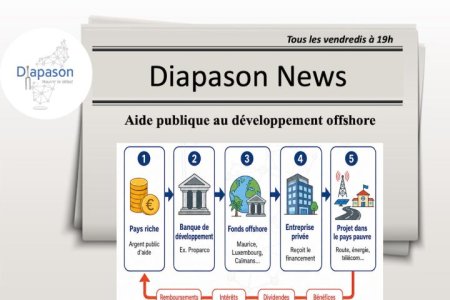
Public development aid rests on a simple promise: wealthy countries with capital support those lacking it to finance roads, schools, electrical networks and essential services. This promise remains necessary. But its architecture has fundamentally transformed. An increasing share of aid no longer flows directly through states. It passes through development banks, investment funds, holding companies and large private enterprises. The paradox begins here: money intended to strengthen poor countries can circulate through the same financial centers that allow part of their wealth to escape. The long detour of aid In 2014, controversy erupted around Proparco, a subsidiary of the French Development Agency (AFD) dedicated to the private sector. A question posed to the French Senate drew on revelations from Canard enchaîné: over 400 million euros allegedly invested over ten years through companies or funds based notably in Mauritius, the Cayman Islands or Luxembourg. The official response did not contest the use of these structures. It explained that the territories concerned did not fall, according to the criteria retained, into the category of non-cooperative jurisdictions. All the difficulty lies in this nuance. A financial center can be offshore, offer advantageous taxation and strongly protect investor confidentiality, without appearing on an official blacklist. Formal legality does not erase political contradiction. Proparco now claims to apply strict procedures against money laundering, corruption and embezzlement, and maintains that no fund it finances is registered in a non-cooperative jurisdiction. This is not to say the institution organizes fraud. It is to pose a more troubling question: can an operation respect all lists and remain contrary to the spirit of development? The mechanism is simple. A wealthy state entrusts public money to a development bank. This bank finances a fund, sometimes established in an international center chosen for its legal and fiscal stability. The fund then lends to a private company that builds a power plant, telephone network or infrastructure. The project exists. But the company repays the loan, pays interest, distributes dividends and compensates several intermediaries. Part of the value produced then returns to investors, sometimes via the same offshore route. Loan repayment, interest or dividend payments are not abnormal in themselves. The question concerns their proportion, transparency, tax treatment and the share of value durably retained in the country. The country receives the infrastructure. It does not necessarily retain the wealth. The aided continent financing the world Africa is often described as a continent lacking capital. This representation tells only half the story. The continent receives aid, loans and investments, but also loses resources through trade misinvoicing, tax evasion, undeclared exports, profit repatriation and capital flight. The United Nations Conference on Trade and Development (UNCTAD) estimates illicit financial flows leaving Africa annually at 88.6 billion dollars, or 3.7% of its gross domestic product. It notably highlights the role of underinvoicing commodity exports, particularly gold. As a rough measure, the Organisation for Economic Co-operation and Development (OECD) figures net bilateral aid from Development Assistance Committee member countries to Africa in 2025 at 29 billion dollars. These figures are not strictly comparable. They nonetheless illustrate a structural imbalance: wealth outflows reach volumes comparable to, or exceeding, the most visible aid inflows. It is the principle of the leaking bucket. We celebrate sums paid at the top, but poorly measure what flows out the bottom. Public debate asks how much Africa receives. It should also ask how much it loses before even needing aid. Nairobi 2026: aid changes scale The Africa Forward Summit in Nairobi in May 2026 offers a contemporary illustration of this transformation. Proparco, Yas and AXIAN Energy signed a strategic protocol. This is not a public contract won by AXIAN, but Proparco's intention to mobilize up to 300 million euros over three years to support the group's expansion. Envisaged tools include corporate financing, project bonds, equity co-investments and funds.
Source: Madagascar Tribune