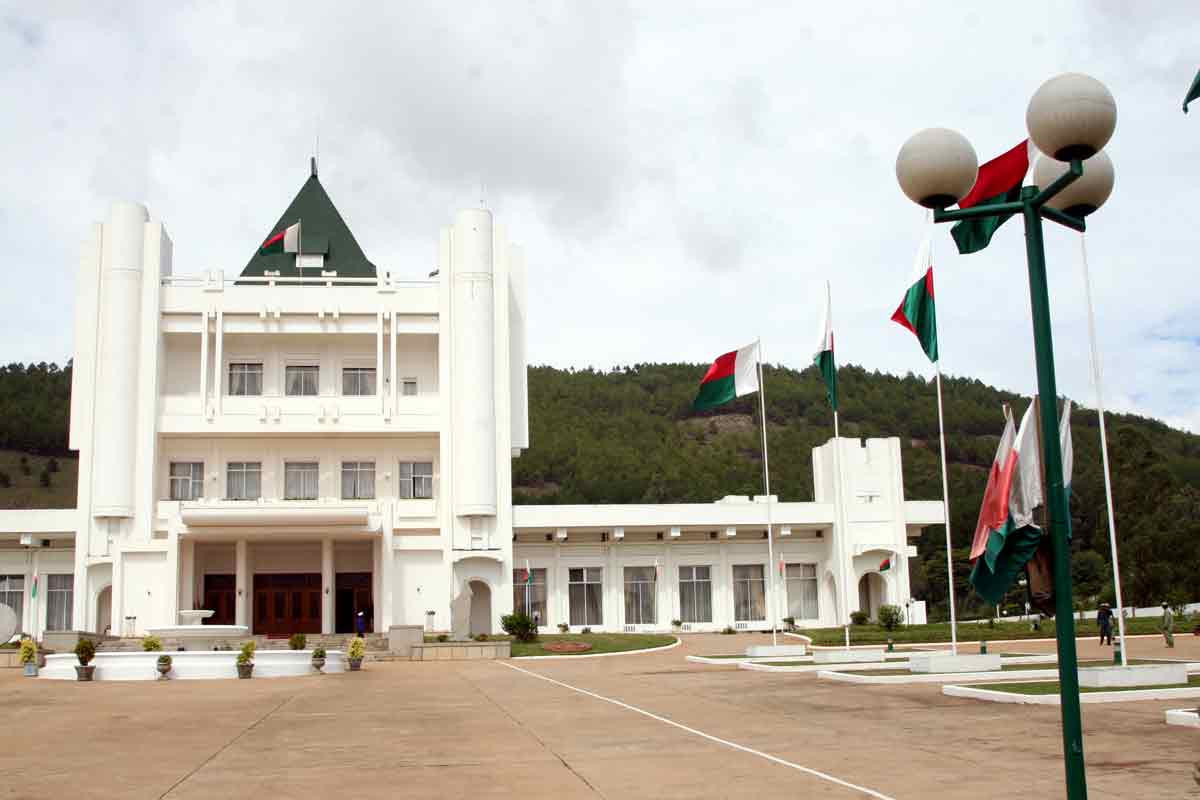
"The way politics is conducted has barely changed. Voices change, faces too, but the discourse remains the same as that of previous generations," sighs Adoré Rahajaniaina, a 65-year-old observer of public life. At his age, he has witnessed several political transitions and possesses the perspective needed to measure the system's permanencies. Many Malagasy share this observation. Leaders succeed one another, but the mechanisms of power seem frozen in time. Political labels change according to crises, elections, or transitions. However, practices, language, and power dynamics often give the impression of an almost unshakeable continuity.
Time passes, habits remain! "Filoha hajaina," "Raiamandren'ny Malagasy"... These formulas, among many others, still punctuate official ceremonies. Pronounced during the First Republic, then widely popularized during the Second, they have never left the vocabulary of masters of ceremony, protocol officials, and hosts of major events, whether at Iavoloha or during infrastructure inaugurations across the country. "It's a mark of respect. Rulers are considered the fathers of the people," explains Mimoza Bary, a former host much sought after during official visits to Anjiabe, south of Nosy Komba island. Behind this justification lies a deeper reality. Despite political changes, part of the population continues to see itself more as a subject of authority than as a citizen with rights. The heritage is heavy, like a burden. From another angle, Professor Jeannot Rasoloarison describes leaders who readily behave like "petty kings." An attitude that, according to him, has roots in governance modes inherited from the precolonial period.
A matter of lineages. French colonization did not overturn this logic. Rather, it recycled it. To effectively administer territories, the colonial administration relied on village chiefs, ampanjaka, and local notables. In exchange for their loyalty, these olobe enjoyed privileges that allowed them to educate their children, sometimes even in metropolitan institutions. What follows is almost social mechanics. Sons succeed fathers. Networks are transmitted as much as patrimony. Thus emerges a category of "people of power," to use the expression of historian and ethnologist Didier Galibert in "Les Gens du pouvoir à Madagascar. État postcolonial, légitimité et territoire (1956-2002)" (Karthala, 2009). The work shows how personal relationships, family alliances, and common interests durably shape the exercise of power, often far more than institutions themselves. Regimes pass; networks adapt. Galibert's choice of study period is not insignificant. From the eve of independence to the 2002 political crisis, Madagascar's history appears less as a succession of breaks than as a remarkable continuity. Crises give the impression of reshuffling the deck, but the players often remain from the same circle.
The club of rulers. In 46 years, eight men have held the helm of state: teacher Philibert Tsiranana, General Gabriel Ramanantsoa, Colonel Richard Ratsimandrava, General Gilles Andriamahazo, frigate captain turned Admiral Didier Ratsiraka, Professor Albert Zafy, jurist Norbert Lala Ratsirahonana, and self-taught entrepreneur Marc Ravalomanana. Different profiles, varied paths, sometimes opposing ideologies. Yet all eventually evolved in the same political universe, with often comparable reflexes. As if the system always ended up shaping those who claimed to transform it... The fabrication of this elite, if one can use the term, dates back far. From colonization to today, circles of power reproduce with remarkable regularity. Displayed rivalries sometimes mask ancient proximity. "They pursued their studies in the same institutions. Many shared the same school benches. They also frequented the same associations," observes sociologist Sahondra Elisa Raveloniarivo, specialist in Malagasy political elites. In short, in Madagascar, opposition and power sometimes give the impression of being two rooms of the same house.