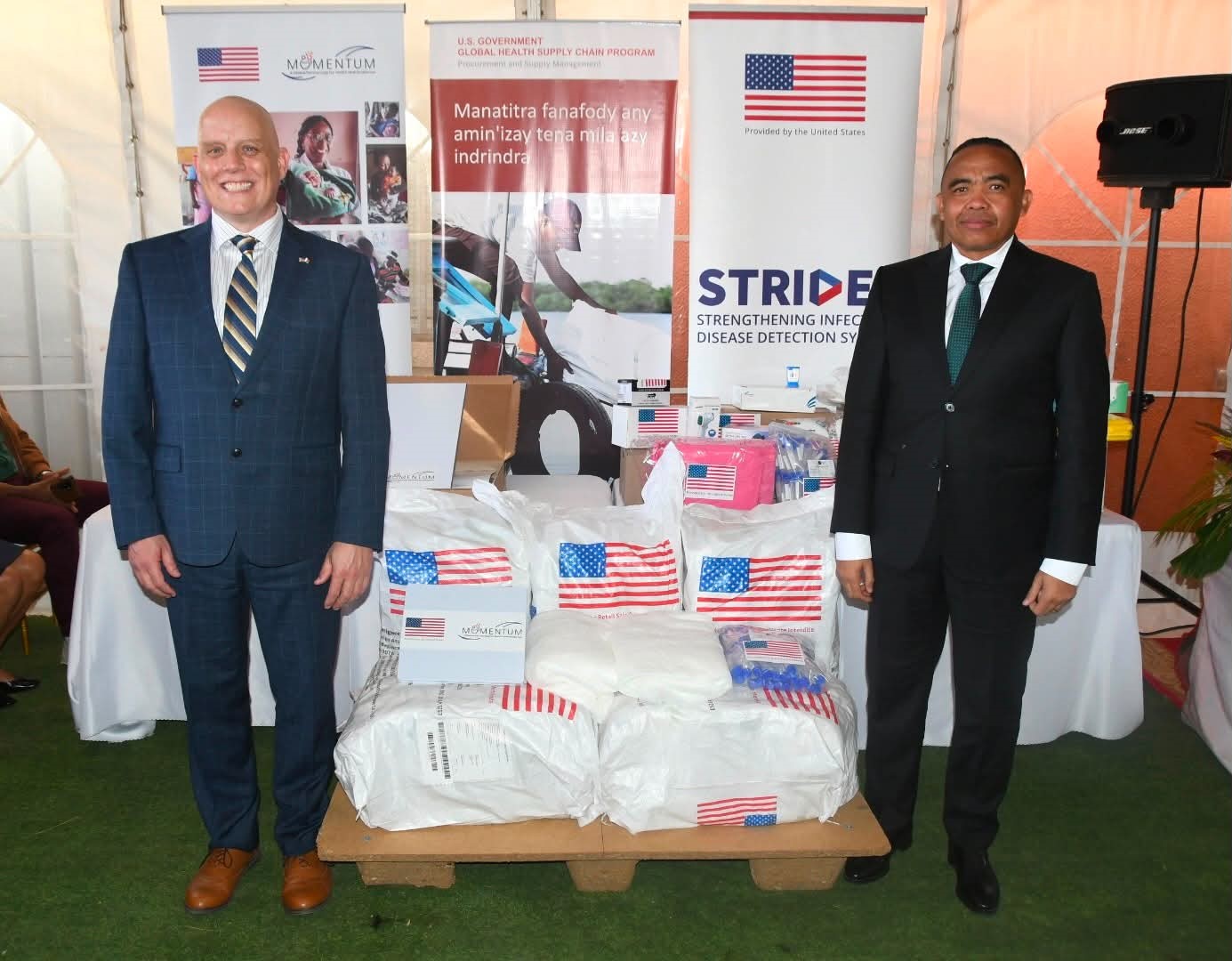
Nearly one million insecticide-treated bed nets, over 900,000 essential laboratory equipment items, and 33 internet connection systems were officially handed over by the United States yesterday, in the presence of Madagascar's Refondation de la République president and US Chargé d'Affaires Steve Bremner. These medical supplies and equipment, valued at over $2.2 million, are part of a broader health partnership between the United States and Madagascar, defined in a memorandum of understanding signed in December 2025, which provides for total US government financing of $134 million for the 2026-2030 period. Specifically, this assistance includes 989,250 long-lasting insecticide-treated bed nets valued at $2 million; 908,523 essential medical and laboratory equipment valued at $180,000; and $30,000 in financing for internet connectivity for health professionals in isolated areas.
Malaria remains one of the leading causes of mortality in Madagascar, claiming the lives of children and women at an unacceptable rate, the US Embassy emphasizes. The use of long-lasting insecticide-treated bed nets is among the key measures to combat this disease. The third and final shipment of bed nets arrived in late June and will be distributed from July through mid-October, enabling the most vulnerable populations to access this protection. The Global Health Supply Chain Program – Procurement and Supply Management (GHSC-PSM) will handle distribution of the nets across 63 districts and 1,661 community health centers nationwide.
Laboratory equipment provided by the United States includes personal protective equipment, laboratory supplies, diagnostic tools, and cold chain materials, as well as a modernized digital surveillance system. Regarding internet connectivity financing, funds have been allocated for the purchase, installation, and first year of service for 33 Starlink satellite internet access systems in priority districts and regional health directorates across the country. These systems will enable health professionals in underserved communities to rapidly transmit health data to central decision-makers, facilitating faster and better-coordinated interventions during epidemics. This support, provided under the STRIDES program (Strengthening Infectious Disease Detection Systems), strengthens Madagascar's capacity to detect and respond to epidemics such as monkeypox, plague, rabies, poliomyelitis, and Ebola before they become regional or global threats. The Momentum Country and Global Leadership (MCGL) will implement this project.
Society
US Delivers $2.2M in Medical Equipment and Internet Access to Madagascar
Source: Midi Madagasikara