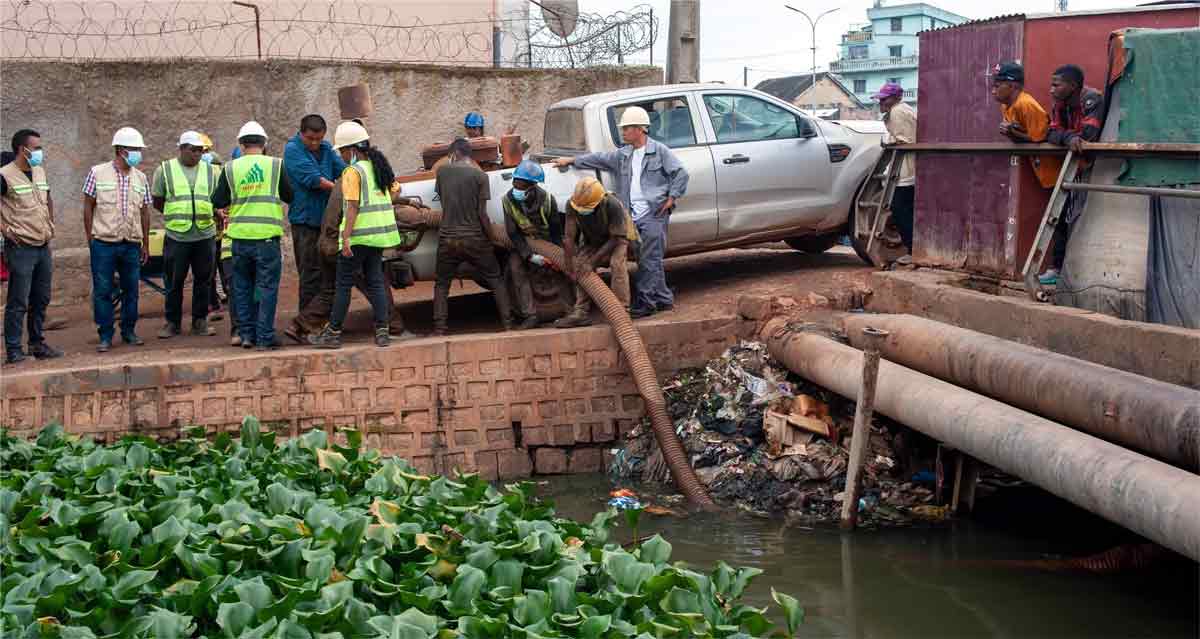
A major milestone has been reached for the resilience of Madagascar's capital. Yesterday, the State, through the Ministry of Land Planning and Land Services, officially closed the Integrated Urban Development and Resilience Project for Greater Antananarivo, known as PRODUIR. Financed by the World Bank, this large-scale program, completed in June, aimed to sustainably transform living conditions in the most precarious neighborhoods of the agglomeration. Facing rapid demographic expansion of the capital, PRODUIR directly tackled the vulnerability of populations to natural hazards. Actions were organized around four major axes: rehabilitation of the urban framework, strengthening institutions for modern governance, rigorous monitoring and evaluation, and deployment of a contingent emergency response component. Nearly 650,000 people in Greater Tana are now permanently protected from flooding, according to project forecasts.
The heart of this initiative relied on critical infrastructure projects, notably the rehabilitation of the C3 canal over 12 kilometers and the restoration of the Ikopa and Sisaony dikes. The canal dredging allowed the extraction of over 115,000 cubic meters of mud, directly securing 430,000 people living in the Antananarivo plain, particularly in the 1st, 4th and 6th districts as well as the peripheral communes of Anosizato Andrefana, Bemasoandro and Andranonahoatra. Beyond hydraulic protection, the project stimulated the local economy by generating over 126,000 person-days of employment during works executed between 2022 and 2025. In total, 587 infrastructures were constructed and strategic equipment, such as a generator for the Ambodimita pumping station and a bulldozer, were handed over to municipal and land services to ensure the sustainability and maintenance of these new assets.