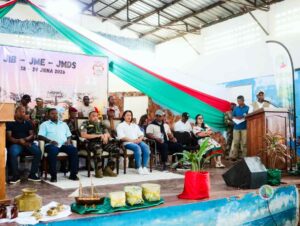
Facing accelerated forest degradation, intensifying droughts and mounting pressure on ecosystems, Madagascar acknowledges entering a genuine environmental crisis. Gathered in Morondava for joint celebrations of major global environmental days, authorities—including the president of the Refoundation of the Republic of Madagascar and senior advisors—painted an alarming picture while announcing a new action phase based on expanding protected areas, restoring natural habitats and unlocking economic value from forests through carbon financing mechanisms.
Morendava, symbol of triple environmental celebration
Morendava, in the Menabe region, became the symbolic center of a strong message from Malagasy authorities last week. Environmental protection is no longer a sectoral issue but a national priority facing a systemic ecological crisis. The joint celebration of World Environment Day, International Biodiversity Day and World Day to Combat Desertification and Drought provided a framework for reassessing the country's environmental challenges. For the first time, a Republic president participated in a global celebration of this scale in Morondava, underscoring the strategic importance accorded to this region.
For Andriantsihala Nolave Luc Aristide, choosing Menabe is not coincidental: a territory rich in biodiversity featuring the Avenue of the Baobabs, Kirindy, Makay and Menabe Antimena, it is also identified as "a zone particularly vulnerable to climate change effects."
A region under climate and social pressure
In remarks during the joint celebration day, the Environment and Sustainable Development minister stated bluntly: "Madagascar is today in environmental crisis." According to him, "degradation of natural resources, diminishing water sources and intensifying extreme climate phenomena reflect an already critical dynamic." Indeed, southern droughts combined with population migration to Menabe intensify pressure on already fragile local ecosystems.
In this context, authorities establish direct links between deforestation, resource scarcity and worsening natural disasters. Declining water resources would thus fuel intensified cyclones and flooding, illustrating a causal chain where environmental, economic and social impacts are tightly interwoven.
Toward "measurable" environmental management
Facing this situation, the Malagasy government claims to enter a "new phase of environmental management based on measurable results." This rests notably on expanding protected areas, restoring degraded forests and strengthening mangroves.
Several decisions were announced during Morondava celebrations, including adoption of four decrees creating new protected areas, complementing 21 recently established. This dynamic reflects accelerated conservation policy nationwide. The Environment and Sustainable Development minister also emphasized current limitations of nature protection systems, noting that "a forest agent must today cover approximately 40,000 hectares," a ratio deemed insufficient for effective natural resource surveillance.
In the same vein, combating bushfires and forest fires is called to become a reinforced national priority.
Carbon financing, new environmental policy tool
Beyond assessments, the triple event organized in Morondava was also marked by presentation of four carbon checks from climate financing mechanisms. The checks benefit 119 communes spread across several country regions, as well as protected area managers, regional chiefs and local communities.
These financings reflect growing economic value accorded to forest conservation within international carbon offset mechanisms. This logic fits within a dynamic already illustrated by the REDD+ program of Atiala Atsinanana, which enabled selling millions of carbon tons and generated substantial resources for conservation and local development.
Domestic
Andriantsihala Nolave Luc Aristide: "No effective climate action without ending deforestation"
Source: Midi Madagasikara