Domestic
Urbanization: Illegal landfill on By-Pass raises Greater Antananarivo expansion questions
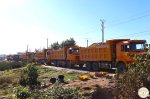
The issue of landfilling in the capital and surrounding areas has resurfaced following Colonel Michaël Randrianirina's intervention on the By-Pass road. Inspections conducted by authorities have reignited a long-standing debate about Greater Antananarivo's development. Behind the announced sanctions against irregular work lies another reality: the capital continues to expand, and this urbanization will inevitably require new land development, provided everything is done legally. Wednesday evening, while returning from the Council of Ministers held at Iavoloha State Palace, the President of the Refoundation of the Republic of Madagascar ordered the immobilization of several trucks carrying landfill material on the By-Pass road. The vehicles remained in place until the following morning for public verification. Thursday, the Head of State returned with the Minister of Land Planning and Land Services, General Lylyson René de Rolland. After initial inspections, the minister indicated that the land in question is indeed intended for construction, but no authorization had yet been issued by his department. Work had therefore been undertaken outside regulatory framework. The president also stated that other trucks had been intercepted at Ambohimanambola, suggesting these practices extend beyond Alasora. Authorities announced vehicle impoundment, immediate work stoppage, site sealing, refusal to issue building permits to the developer, and sanctions against vehicle owners and work supervisors. They also reminded that all landfilling must be preceded by technical study and authorized by the Ministry of Land Planning and Land Services. This case recalls that landfilling is not new to Antananarivo. Much of the current capital developed through drainage, landfilling and development operations throughout its history. In the early 20th century, French colonial administration drained and filled about twenty hectares of marshes and rice paddies at the foot of the Upper City to create the Analakely district, now considered the capital's economic heart. These works also enabled development of Independence Avenue, Analakely stairs and Soarano station. Mahamasina's development also reflects this gradual city transformation. During colonization, major drainage, landfilling and sanitation works were undertaken in this vast plain to enable urbanization and new infrastructure construction. After independence, this momentum continued with creation of the 67 Ha city. Work began in 1967 on a sector then outside the urbanized city. The site was still almost entirely occupied by rice paddies with only scattered buildings. This project also illustrates how Antananarivo gradually expanded toward its peripheries. These historical reminders show Antananarivo's urbanization was partly built through landfilling. With constantly growing population and an urban municipality now largely saturated, opening new neighborhoods, constructing housing, schools, hospitals, roads or business zones will still require new space development in neighboring municipalities. Landfilling should therefore continue accompanying Greater Antananarivo's development. However, it can no longer proceed without rigorous planning. Each project must respect administrative procedures, technical studies and environmental requirements. New zone occupation must also include structures preserving the capital's hydraulic balance. Creating retention basins, buffer zones, efficient sanitation networks and other infrastructure limiting flood risks must be integral to each development program. This responsibility primarily falls to the State, called to organize the capital's expansion while reconciling urbanization, environmental protection and population safety.
Source: Madagascar Tribune