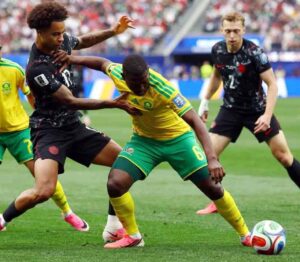
In the round of 16 of the 2026 World Cup, four African teams – South Africa, Côte d'Ivoire, the Democratic Republic of Congo (DRC), and Senegal – experienced cruel scenarios, losing their grip in the final moments of matches they dominated or controlled. None of these collapses occurred before the 70th minute. The real common thread? A collective inability to manage a position of strength and secure the result, despite evident competitiveness against more established nations. Is this a structural problem linked to experience in major tournaments, mental preparation, or tactical weaknesses late in matches? Or simply a transitional episode in African football's progression? This investigation explores, match by match, these late-game dramas.
South Africa 0-1 Canada: The fatal goal in stoppage time
The Bafana Bafana held their own against co-hosts Canada from kickoff in a fiercely contested match. They resisted with discipline, frustrating opposing attacks for nearly the entire encounter. But in added time (92nd minute), Stephen Eustáquio unleashed a stunning long-range strike that beat Ronwen Williams. This goal eliminated South Africa, who were playing their first-ever Round of 16. Despite the defeat, South Africans can be proud of a solid campaign, notably marked by a hard-fought qualification from the group stage.
Côte d'Ivoire 1-2 Norway: The equalizer falls short
The Elephants, led by pragmatic Emerse Faé, delivered an intense battle. Amad Diallo equalized in the 74th minute, restoring hope to an entire nation after a difficult start against Norway's attacking duo (Haaland, Sørloth). But Erling Haaland, omnipresent, scored the winning goal in the 86th minute, sealing Côte d'Ivoire's elimination. The Ivorians "gave everything," according to their coach, but lacked the maturity to hold the score in the final moments. Immense regret for a team that had shown promise in the group stage.
DRC 1-2 England: Kane's brace in the closing stages
The Leopards created a sensation by leading 1-0 from the 7th minute, thanks to a magnificent goal by Brian Cipenga. They resisted valiantly for over an hour, holding their own against a favored England. Until the 75th minute, hope was justified. But Harry Kane then took matters into his own hands: a brace within eleven minutes, including a decisive goal in the 86th, reversed the match (2-1). The DRC demonstrated remarkable resilience but paid dearly for a fatal lapse in managing the match's conclusion.
Senegal 2-3 Belgium (a.e.t.): Self-inflicted collapse
The most spectacular and painful scenario. The Lions of Teranga led 2-0 until the 85th minute against a struggling Belgium. Everything seemed settled. Then, within minutes, the Belgians equalized through goals from Romelu Lukaku and Youri Tielemans (one from a penalty). In extra time, another Belgian goal (125th minute, penalty converted by Tielemans) finished Senegal (3-2). A Senegalese player even called this defeat "self-inflicted" rather than suffered, pointing to individual errors and collective mismanagement once the advantage was secured. A rare collapse for a team accustomed to solidity.
A common denominator: managing leads late in matches
Four teams, four different technical staffs, one damning conclusion: the turnaround systematically occurs in the final quarter-hour (or in extra time). When it's time to shift from a phase of construction and dominance to rigorous defensive management, the cracks appear – concentration drops, technical errors, mental fatigue, or lack of experience in high-intensity scenarios. African football clearly proved, during these matches, its capacity to rival major nations. But converting a dominant position into victory remains a recurring challenge. These eliminations raise broader questions about psychological preparation, squad depth, or game models adapted to tense match finales. Nevertheless, these campaigns remain encouraging: several of these teams reached the Round of 16 for the first time or with distinction. The path to maturity likely passes through cold analysis of these "late-game curses." African football is not cursed; it is evolving. Report compiled by Heriniaina Samson