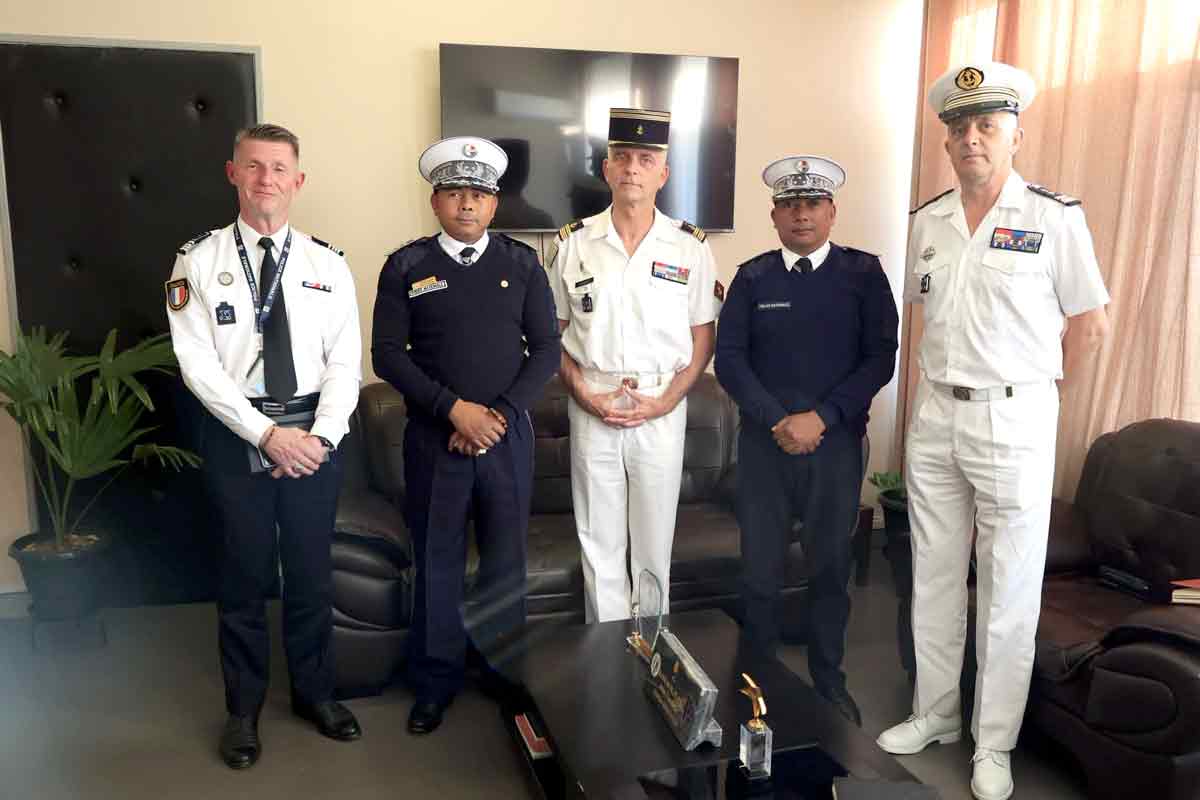
Colonel Olivier Ducret, head of the DCSD at the French Ministry of Foreign Affairs, made an official courtesy visit to the Ministry of Public Security in Anosy yesterday. As Russian influence grows in the island nation, particularly in military affairs, Paris is not willing to concede ground. Evidence of this lies in the fact that security cooperation between Madagascar and its former colonial power remains particularly active and is intensifying on the ground. It was in this context of geopolitical rivalry that a high-level meeting took place yesterday at the heart of the capital. Colonel Olivier Ducret, head of the Sub-Saharan Africa division within the Defense and Security Cooperation Directorate (DCSD) of the French Ministry of Foreign Affairs, made an official courtesy visit to the Ministry of Public Security in Anosy. Leading a delegation of experts, the senior French officer came to reaffirm Paris's commitment to its historic agreements with Antananarivo.
To welcome the French delegation, the Malagasy National Police dispatched top-level officials. Police Controller General Simon Rakotomalala, director of the General Inspectorate (internal investigations), and Police Divisional Commissioner Ostrom Whenss, director of research and continuous training, led discussions on behalf of Malagasy authorities. Although described as a courtesy meeting, the encounter quickly took on a highly technical and strategic character. At the center of discussions: strengthening police and technical cooperation. Both parties extensively discussed mechanisms to optimize the skills of local law enforcement. Emphasis was placed on continuous training for Malagasy National Police officers, considered an essential lever for continuously improving operational effectiveness on the ground and addressing new security challenges facing the island.
For France, maintaining this cooperation channel is crucial. While Moscow consolidates its gains with the Malagasy general staff, Paris is banking on soft power, strengthening institutional capacities, and technical proximity with community policing and investigative services. This approach aims to demonstrate that France remains a reliable, structured, and indispensable partner for Madagascar's internal security future. This meeting in Anosy proves that, despite the vicissitudes of international diplomacy and the emergence of new strategic partners for Madagascar, the Antananarivo-Paris axis maintains its foundations. The resolutions adopted during this day should soon translate into new training sessions and increased expertise exchanges between the two nations. The Malagasy National Police, in constant pursuit of modernization, appears to find in this partnership substantial support for ensuring its sovereign missions.