Domestic
National Assembly adopts 'Malgachization' law at Tsimbazaza
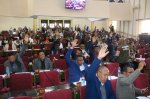
The National Assembly adopted on July 1st a bill on language policy and linguistic rights in the country. Introduced by Navalona Francky Rakotoaritiana, deputy for Antananarivo's 3rd district, the text stipulates that administrative documents, court decisions, employment contracts and all official documents must now have a version written in Malagasy. Presented as a measure to facilitate citizens' access to public services, this reform recalls one of the most significant episodes in Madagascar's contemporary history: the malgachization policy pursued under President Didier Ratsiraka in the 1970s. According to the parliamentarian, the objective is not to exclude French or other foreign languages, but to restore Malagasy to its rightful place in public life. He notes that nearly 99% of inhabitants speak Malagasy and over 80% of the population speaks only this language. For the bill's supporters, this reform must end difficulties faced by many citizens confronted with documents they cannot understand, whether administrative procedures, judicial decisions or professional contracts. National Assembly President Randrianasoloniaiko Siteny has also called on the Ministry of Communication and Culture to develop a genuine public policy for promoting the Malagasy language. He believes this approach strengthens national identity and Malagasy culture. While the law's authors insist this is not "excessive malgachization," the text's adoption inevitably revives memories of the policy pursued during the Second Republic. After taking power in 1975, Didier Ratsiraka made malgachization a pillar of his revolutionary project. Education gradually shifted to Malagasy, while several city names and various administrations were also malgachized to erase French colonial heritage. This policy remains widely debated today. Many historians and specialists believe its implementation faced significant difficulties. Lack of appropriate teaching materials, insufficient technical vocabulary in several disciplines, inadequate teacher training and insufficient preparation contributed to declining school standards in several sectors, before French gradually regained prominence in the education system from the late 1980s and early 1990s. The new text adopted by the National Assembly differs from this historical policy. Parliamentarians assure that it does not aim to replace French, but to guarantee that every citizen can have an official document version in Malagasy. Its implementation will require considerable work. Deputy Navalona Francky Rakotoaritiana himself acknowledges that harmonized legal, administrative, economic and technical vocabulary must be developed to allow uniform use across all administrations and public services. The adoption of this law thus opens a new chapter in Madagascar's language policy. For its supporters, it constitutes a measure of social justice and recognition of the national language. For other observers, it revives memories of a historical experience whose results continue to fuel debate, reminding that any major linguistic reform will depend as much on its preparation as on its implementation methods.
Source: Madagascar Tribune