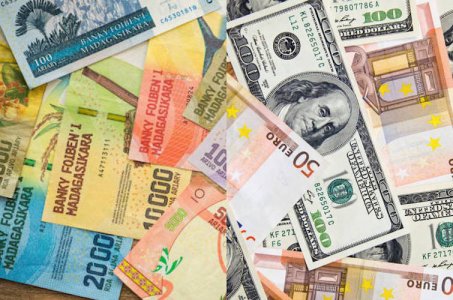
The ariary is showing fresh signs of weakness against major foreign currencies. After a sharp recovery at the start of the year, the Malagasy currency is gradually losing ground against the euro and US dollar. Reference rates from the foreign exchange market currently place the euro around 4,935 ariary and the dollar at 4,323 ariary. Weekly rates applied from September 14, based on central bank data, show precisely 4,935.33 ariary per euro and 4,323.41 ariary per dollar. The trend is also visible at bank counters, where individuals do not benefit from the MID reference rate. For example, BRED Madagascar quoted on Thursday, September 17, a euro bought at 4,720 ariary and sold at 5,216.8 ariary. For the US dollar, the bank shows 4,135.90 ariary on purchase and 4,571.26 ariary on sale. In other words, someone bringing euros to the bank receives 4,720 ariary per euro, while a customer wanting to buy this currency must pay 5,210 ariary. However, this movement must be placed in context. In the first quarter of 2026, the ariary had experienced spectacular appreciation. Between January 5 and March 13, the euro fell from 5,309 to 4,759 ariary, while the dollar declined from 4,580 to 4,149 ariary. The national currency had thus gained nearly 10% against both currencies. Since this March peak, the trend has partially reversed: compared to March 13 levels, it now takes approximately 176 additional ariary to obtain a euro and 174 additional ariary for a dollar.
Pressure from foreign currency needs
This depreciation can first be explained by the functioning of the Interbank Foreign Exchange Market (MID). When companies, particularly importers, need more euros or dollars to settle their foreign purchases, demand for foreign currency increases. If inflows from exports, investments, projects, or transfers do not grow at the same pace, currencies become more expensive in ariary. More national currency is then needed to buy a euro or dollar. The opposite phenomenon had indeed supported the ariary in early 2026. Foreign currency revenues, particularly from export sectors, had strengthened supply on the market, while regular trading volumes had helped limit volatility. The situation especially recalls the strong tensions observed at the end of 2025. In September of that year, weekly rates already reached 5,180.89 ariary for the euro and 4,460.82 ariary for the dollar. By December, pressure had intensified further. The week of December 15 showed the euro at 5,115.07 ariary and the dollar at 4,472.57 ariary. At year-end, levels were even higher: 5,228.81 ariary per euro and 4,525.36 ariary per dollar from December 29. The ariary has therefore not yet returned to the particularly difficult levels of December 2025. It remains, at current rates, approximately 5.6% stronger against the euro and 4.5% stronger against the dollar than at year-end. But the reversal observed since March is a signal to watch. For an economy heavily dependent on imports—fuel, equipment, raw materials, and certain consumer products—continued depreciation would mechanically increase the foreign currency bill. Ultimately, this increase could be passed on to business costs and then to prices paid by consumers. The question will therefore be whether this ariary decline remains a correction after its strong early-year appreciation or marks the beginning of a more lasting trend in the foreign exchange market.