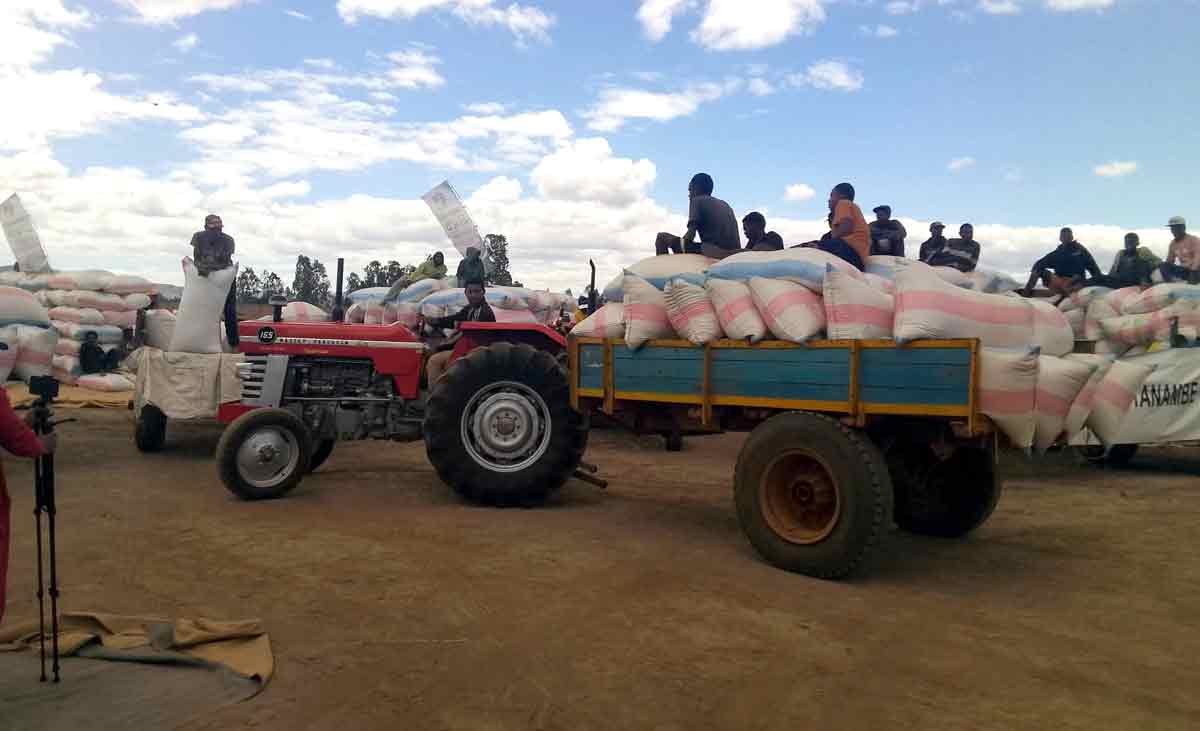
Local producers are ready to sell their harvest stocks thanks to the incentive price set by SPM. Since the rice collection campaign opened in the Alaotra-Mangoro region on May 4, 2026, less than 10% of production has been marketed to other regions. "There are still approximately 500,000 tonnes of paddy in stock, or nearly 300,000 tonnes of white rice to evacuate," declared Alaotra-Mangoro regional chief Elire Rabemananjara during the launch of the direct paddy purchase operation by state company SPM (State Procurement of Madagascar) in Amparafaravola district. Local producers confirm that each currently holds 10 to 20 tonnes of paddy in stock. According to their accounts, the purchase price for this essential commodity set at 1,500 Ar/kg proves incentive, while local market prices fluctuate between 1,200 and 1,350 Ar/kg.
SPM Intervention. The regional chief mentioned reluctance from 269 formal collectors surveyed, facing instability in major urban markets where imported rice sold at highly competitive prices could directly compete with local production. "These operators often resort to bank loans to finance their collection operations. They thus need guarantees on regular outlets to these major urban markets to avoid cash flow blockages. SPM's intervention, which purchases 1,500 tonnes of paddy at once, represents a major first in the region's history," he emphasized. This direct purchase operation will be renewed through a revolving fund system once the 1,500 tonnes of paddy, previously hulled by SPM, have been sold to partner wholesalers on the domestic market. A second purchase operation is already planned shortly.
Transforming Paddy. Additionally, a regional decree setting the amount of rebates collected from operators came into force at campaign launch on May 4, 2026. This text stipulates that economic actors pay double the rebate amount if they market unhulled paddy outside Alaotra-Mangoro region. "We thus encourage operators to process paddy locally to create local added value and curb speculation, especially since some hulling mills had to be put on technical standby due to lack of supply. In parallel, rebate collection rates have improved thanks to digitalization deployment," clarified Elire Rabemananjara. To support the upstream sector, Alaotra-Mangoro region collaborates closely with communes in various districts. Rural roads have notably been rehabilitated in fokontany to facilitate collector access to production zones.
Economy
Alaotra Mangoro: '300,000 tonnes of rice to evacuate', says regional chief Elire Rabemananjara
Source: Midi Madagasikara