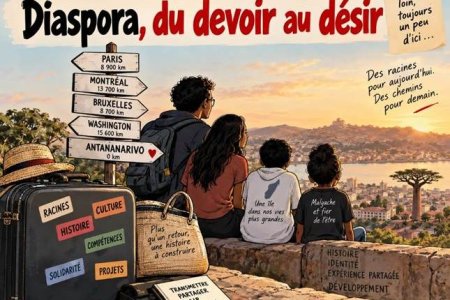
The Malagasy diaspora is summoned everywhere, yet viewed solely as a resource to tap: transfers, skills, investments. One question is missing: why would they want to do it? A diaspora is not hereditary; it must be rebuilt with each generation, and desire cannot be decreed. As Madagascar prepares for its National Diplomatic Assemblies, a case for shifting from duty to desire: giving new generations a real reason to stay in the family.
The invitation to participate in Madagascar's National Diplomatic Assemblies brought me face to face with a subject we discuss constantly: the diaspora. It is summoned everywhere—in national strategies, ministerial speeches, conferences, workshops, consultant reports and institutional PowerPoints where arrows connect Paris, Montreal, Brussels or Washington to Madagascar. On the slides, everything circulates: money, skills, investments, networks, expertise. Generally, only people are missing.
Because we almost always start with what the diaspora could bring. How much does it transfer? How much could it invest? How do we mobilize its skills, attract its entrepreneurs, bring back its researchers? But one question is always absent: why would they want to do it?
We have become remarkable plumbers
The National Letter of Policy on Diaspora Engagement (LPNED) is interesting. No need to criticize it unfairly. It recognizes the diaspora as an actor in development and mentions trust, youth, culture, mobility, investment, skills and participation. But its logic remains classical: the diaspora possesses resources, so let us organize to better mobilize them. Financial, economic, technical, professional, cultural, political capital—it clearly has plenty. We are reassured. Now we must find the right taps: facilitate transfers and investments, improve procedures, identify skills, open service windows. We have become remarkable plumbers of the diaspora. But here is the thing: a pipe, however well-regulated, does not produce water. And we think far less about the source.
A diaspora is not hereditary
For someone who left Madagascar at thirty, belonging is not abstract. Family remains, the house, the village, the words, the memories. But his son? His granddaughter? The young man born in Lyon who vaguely understands Malagasy? The young engineer in Brussels for whom Madagascar amounts to vacations and family commentary on politics? We sometimes act as if diaspora were transmitted genetically. Unfortunately, identity is not a blood type. A diaspora must be rebuilt with each generation.
What is interesting is that the LPNED almost knows the answer. In its definition appear three essential notions: history, identity, shared experience. But when the LPNED becomes operational, these words fade behind the instruments. We know what creates a diaspora. Then we organize mainly what it could produce. It is like knowing the conditions for growing a tree and then devoting agricultural policy to counting the fruit.
Return to roots is a curious idea
The LPNED speaks of language, culture, youth, of "return to roots." Fine. But this expression assumes that a Malagasy identity awaits the young diaspora member, stored in a cupboard between a lamba and some sepia photos. A young Franco-Malagasy is not a Malagasy temporarily lost in France. He is also French. This plurality is precisely the wealth of a diaspora. His identity is not to be restored. It is to be built. We must not only prevent him from "losing" Madagascar, but ensure the country is alive and familiar enough that he wants to keep it.
And history in all this? We readily speak of culture, language, music, gastronomy. But what do we transmit of our history? What does a young diaspora member know of kingdoms, resistances, colonization, 1947, independence, political choices, successes and dead ends? What does he know of those who thought, fought, taught, created, healed, undertook? One hardly belongs to a history of which one knows no figures.
This is not about fabricating a well-pressed national novel where everyone was heroic for four centuries. Between patriotic propaganda and amnesia, a place exists. We need heroes. Even imperfect ones. The word provokes a cringe in the properly educated intellectual. He imagines statues, anthems, military mustaches and some abuses committed in the name of the Fatherland. We simply need figures showing what a Malagasy could do: researcher, writer, doctor, entrepreneur, artist, teacher.