Domestic
Where to Hold On – Chapter 3. The Shortcut That Should Not Exist
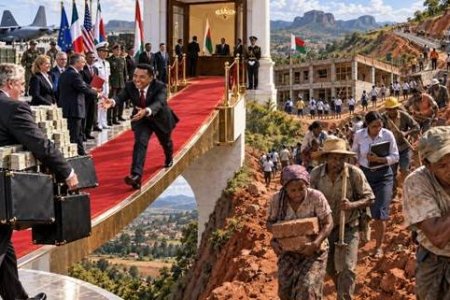
This four-part reflective work emerged from a turning point: Madagascar's accelerated rapprochement with Russia — diplomatic recognition, economic agreements, military trainers — presented as a change of era. Many see it as a geopolitical rupture. I saw something else: the repetition of an ancient gesture, that of a power seeking outside the legitimacy and means it no longer finds within. It is this gesture, more than the partner of the moment, that this tetralogy seeks to examine: where does it come from, what does it cost, how to escape it. The first part showed how the power incentive structure rewards the survivor over the builder; the second, that visions have never been lacking, but rather the architecture — fiscal first — capable of making them survive their author. This third part offers a reading of other roots of the evil: extraversion, the colonial shift, and that shortcut which autonomous states never had. Madagascar did not suffer from having too few resources. The country suffered from always finding, in critical moments, someone to spare it from building its own. III. The Shortcut That Should Not Exist The trap of the false 'mentality' argument Having reached this point in the argument, a temptation awaits us. It is ancient, comfortable and above all very economical in terms of brainpower: explaining everything by 'mentality'. Malagasy elites would thus have a short-term mentality. They would lack responsibility, sense of state, vision. One would simply need to date the appearance of this strange disposition of mind and, presto, we would have the explanation… Mentality is a convenient scapegoat. For the same reasons we rejected, in the previous part, explaining everything by corruption, we must resist this ease here. Invoking a 'mentality' explains little. It simply displaces the problem to the culturalist terrain, where everyone can bring their anecdote, their proverb and their ideal Malagasy. The discussion is then quickly closed, precisely when it should begin. Political scientist Jean-François Bayart provides us with a far more demanding tool: extraversion. Extraversion, instructions for use Contrary to dependency theories that readily described our countries as passive victims of a global system, Bayart proposes in The State in Africa another analytical framework. African elites do not merely suffer their relationship with the outside. They also know how to use it well. International recognition, economic aid, financing, political alliances, military support: all external resources capable of being converted into internal power. Dependency ceases to be merely the infernal yoke imposed by necessarily greedy and malevolent foreign powers. It can also become a strategy. The idea, fundamentally, is quite simple. When a power struggles to obtain from its own society the authority, resources or support it needs, it can seek them elsewhere. Recognition from a great power, money from a donor, weapons from an ally then replace what taxes, citizen support or solid institutions do not provide. The outside becomes the crutch of the inside. And a crutch, everyone knows, has the advantage of allowing one to walk without having quite repaired the leg. An extraverted power is therefore not necessarily a weak power condemned to suffer. It is also a power that has discovered it could be more convenient to finance, protect or legitimize itself elsewhere than at home. This analytical framework has another merit: it resists overly easy dating. For extraversion was not born with colonization. Radama I offers even, in precolonial Madagascar, a particularly accomplished illustration. Where his father Andrianampoinimerina had built the bulk of his power on internal resources — notably the fanompoana mobilized for rice paddies we encountered in the previous part — Radama seeks outside some of the means he lacks to dominate the island. The 1817 treaty with the British brings him three decisive resources. First, diplomatic recognition: London consecrates him 'king of Madagascar', when he still controls little more than Imerina. Next, annual compensation in arms, ammunition and equipment in exchange for abandoning the slave trade. Finally, instructors capable of training his army in the European manner, soon followed by missionaries and their schools. Recognition, money, arms, expertise: the package is already well-stocked. And it is with these resources from outside that Radama conquers most of the island. The extraverted scheme thus appears complete: a power that finds outside what it cannot build inside.
Source: Madagascar Tribune