Economy
Banking Sector: African Banks in Full Expansion
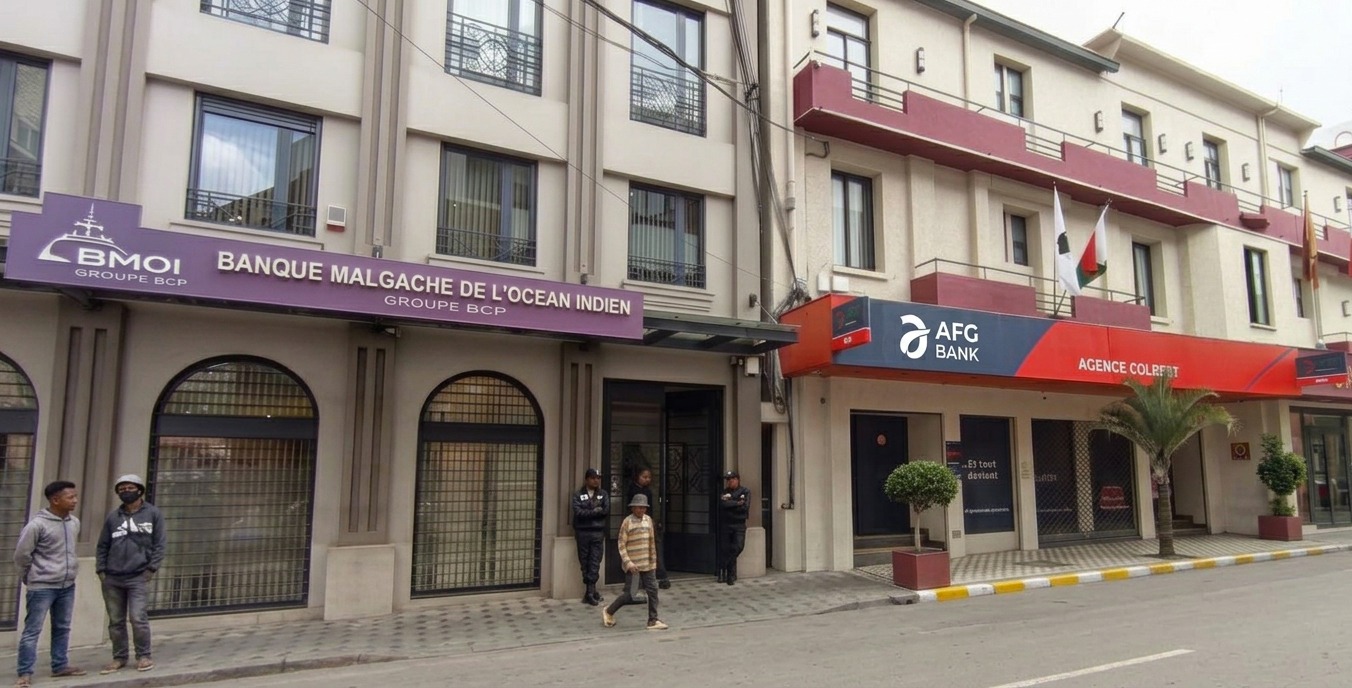
Branches of European and African banks in Antananarivo. The African banking landscape has undergone profound change. Long dominated by subsidiaries of major Western banks, it now sees the emergence of subsaharan-capital banks expanding beyond their original borders. They now stand alongside their South African and Egyptian counterparts, already firmly established. They are reshaping the banking map of the continent, extending to the Indian Ocean. A generation ago, the main banks operating in Africa were often backed by European banks and, to some extent, American ones. Since then, new subsaharan players have asserted themselves, first growing in their domestic markets before gradually expanding into neighboring markets and building genuine pan-African networks. Ecobank and Bank of Africa are the most spectacular illustrations. The former was created in Togo in the 1980s and operates in 33 African countries, while the latter is present in 20 countries, including Madagascar. It is important to note that the expansion of African banks coincides with the gradual departure of Western banks, which view the African market as unpromising. The sale of Société Générale's African subsidiaries, including in Madagascar, is the most recent illustration. African banks have greatly benefited from this to expand their presence on the continent. Change of Scale This evolution goes beyond mere growth of banking networks. Major African groups are also seeking to diversify their operations to cover multiple segments of the financial market across virtually the entire continent. Like AFG Bank, present in 15 countries, including Madagascar and the Comoros. After fully acquiring German Access Bank and its continental network, as well as Société Générale's Guinea subsidiary, this Ivorian bank operates in several niches: traditional banking, microfinance, insurance, and investment banking across multiple countries. Banking competition is thus gradually shifting: it is no longer just about being a country's leading bank, but about being able to support clients when they move to new markets. Virtues of Competition The rise of African banks is accompanied by fierce competition. In fact, these new banks are, in a sense, forced to break new ground, which creates real opportunities for clients, whether individuals, private enterprises, or states. Banks are now interested in underexplored market segments, even financing sectors previously ignored. They compete ingeniously to enter new markets, such as financing certain professions, the mining sector or energy, as well as certain diasporas present in African countries. Today, African banks have become, in turn, conquerors of their own continent. And Madagascar, at the heart of the Indian Ocean, is gradually finding its place on this new African banking map.
Source: Midi Madagasikara