Domestic
Who Educates Our Children?
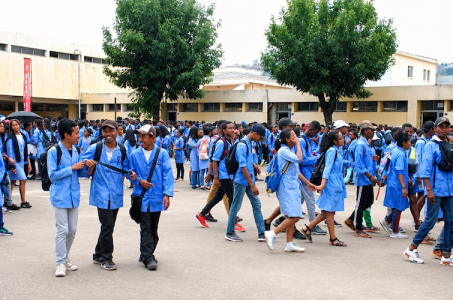
When education is understood as a means of transmitting values and life principles, a pressing question emerges in a context marked by the recent murders of Stéphanie and Haingotiana, young girls killed in tragic circumstances by a gang of drug-addled youths: "Who educates our children?" The natural answer would be: parents. However, they are far from being the only ones involved in the education that gradually shapes a human being. As evidence, children from the same family can take entirely different paths, whether in terms of interests or behavior. Teachers, classmates, friends, extended family, community, and involvement in sports, cultural, and religious circles expand the range of models that forge each child's and adolescent's mentality. Within this web of influences, what share is attributable to parents? How did these boys come to try drugs, to the point of developing addiction? How did they come to lose the distinction between right and wrong, becoming cold-blooded murderers? This tragedy also prompts reflection on educating young people to perceive dangers and make protective choices, without in any way shifting responsibility from perpetrators to victims. The spirit of rebellion and openness to innovation and experimentation inherent to youth complicate the matter. Over decades, each generation of adolescents has been suspected of degeneracy, and each generation of parents has viewed their children's enthusiasms with suspicion: jazz, rock, or rap music, comic books, television, video games—an incomplete list—have been accused in turn of corrupting youth. We must therefore step back and not succumb to panic. Nevertheless, it is undeniable that the explosion of social media has brought both a globalization and multiplication of models and norms, not always favorably. TikTokers become opinion prescribers, K-Pop groups become idols, great athletes and artists inspire careers. But simultaneously, American street gangs or French suburban gangs also offer themselves as models to follow. So many references, more or less desirable, that some young Malagasy may wish to identify with and resemble. In Madagascar's music alone, one can only be astounded hearing certain song lyrics, watching certain clips, and observing the behavior of certain artists on stage. Faced with this phenomenon, public opinion can only deplore verbal and behavioral lapses: "tsy mifanaraka amin'ny soa toavina malagasy!" Yet someone would need to define this famous Malagasy soa toavina served to us constantly, as ancient and contemporary history is full of highly questionable examples and contradictions. Reprehensible models do not always come from abroad. Moreover, a phenomenon has developed in Madagascar that has ended up corrupting current generations. This is werawera, the showing off and exhibition of material success through photos on Facebook, Instagram, or TikTok: wads of cash, luxury vehicles, business or first-class travel and stays in five-star hotels, etc. In an environment marked by poverty and weak educational levels, the perverse effect of werawera is the promotion of a logic favoring the pursuit of easy money and rapid fame, even at the cost of small compromises with law and morality. The long and tedious path of meritocratic success through studies and work no longer inspires dreams. For those not troubled by scruples, involvement in politics offers an accelerated path. For others, provocative poses, outrageous behavior, and extremely vulgar speech are integral to a strategy designed to generate buzz and accumulate likes and followers. A youth under influence(s) These "influencers," in the broad sense, contribute to educating our children. As for the narrow sense applying to Tap Tap Send vendors, one wonders with curiosity what they truly influence and in which direction, other than toward Moscow. Andry Rajoelina is the perfect example of a pernicious model for youth: little education, even less morality, but genuine talent for communication and propaganda that attracted hundreds of thousands of supporters, young and old. This man incapable of simple arithmetic (13 + 6) attempted to make the entire world believe...
Source: Madagascar Tribune