Domestic
Madagascar-US: Private Investment at Heart of Strengthened Economic Partnership
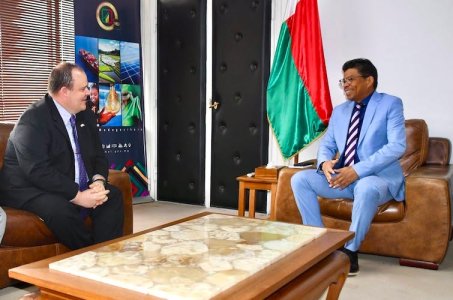
Madagascar and the United States aim to elevate their economic relations to a new level. The two countries intend to promote private investment and develop partnerships across several strategic sectors. This ambition was central to a meeting between Economy and Finance Minister Ramiarison Herinjatove Aimé and Tom Bevan, Chargé d'Affaires a.i. of the U.S. Embassy, on September 1st in Antaninarenina. Infrastructure, energy, water access, health, and strategic natural resources are among the areas identified to deepen cooperation. Washington seeks to facilitate American companies' involvement in projects that could support economic development and sustainable job creation in Madagascar. Tom Bevan presented the American "whole of government" approach on this occasion. This relies on coordinated mobilization of multiple public institutions to support businesses and investments. The U.S. International Development Finance Corporation, the Export-Import Bank of the United States, the Department of Commerce, and the Department of the Treasury are among the agencies that could intervene. On the Malagasy side, private capital appears particularly important given substantial infrastructure needs while public resources remain limited. The Economy and Finance Minister highlighted public-private partnerships as one mechanism to finance projects in roads, electricity, energy networks, and digital infrastructure. A dedicated PPP structure already exists within the ministry. Improving American companies' access to information on available projects in Madagascar was also discussed. The goal is to better publicize investment opportunities and facilitate initiatives of mutual interest. Energy represents another key focus. Madagascar aims to increase renewable energy's share to reduce dependence on imported fuels. On water issues, the American delegation mentioned a memorandum of understanding involving a U.S. company in prospecting available resources. Both parties intend to continue health cooperation. Existing programs focus on laboratories, supply chains, frontline personnel, disease surveillance, and data collection. Malaria control, including distribution of insecticide-treated nets and support for health facilities, features among highlighted actions. This meeting thus reflects the desire to orient relations between Antananarivo and Washington toward concrete economic projects, with the private sector as a key lever.
Source: Madagascar Tribune