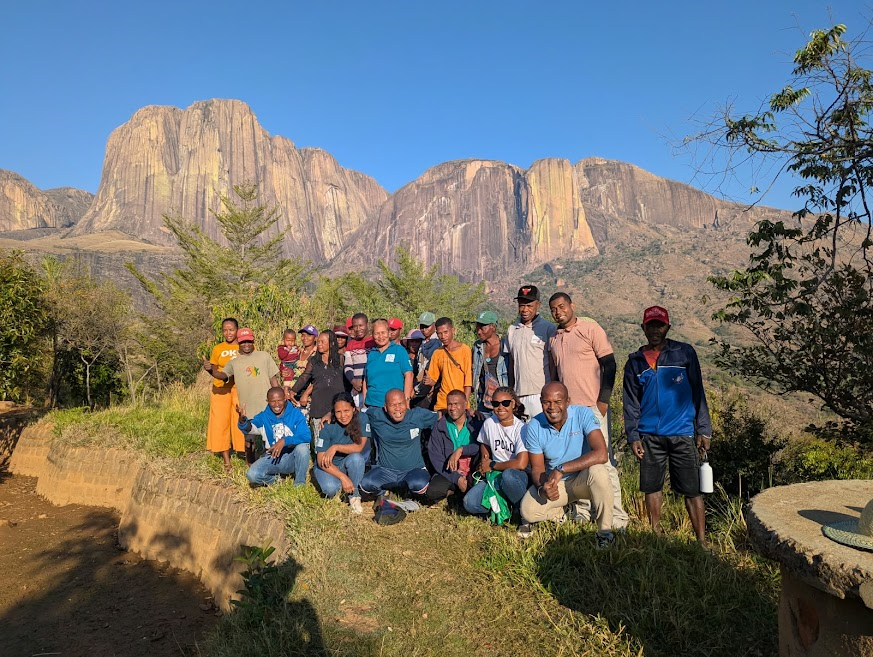
During an exchange visit carried out by the RASIS community to Ambalavao with support from the GEC BATAN project. Nosy Sakatia is part of the intervention zones of the GEC BATAN project (Coastal Ecosystem Management of the Baie d'Ambaro, Tsimipaiky, Ampasindava and Nosy Be archipelago landscape), financed by France through the French Global Environment Facility (FFEM). Nicknamed "the Island of Orchids," it is a preserved destination located off the west coast of Nosy Be. Representatives of the local RASIS community (Grouping of Actors for the Safeguarding of Sakatia Island) recently conducted an exchange visit to learn about the experiences of their peers in Ambalavao, in the Haute Matsiatra region, thanks to support from this project which is starting this year. This involves the COBA "Tantely" community, manager of the Tsaranoro site, known as a world-class climbing spot and a paradise for hikers and trekkers, as well as the VOI Anja Miray community, manager of the Anjà village reserve, renowned for its ring-tailed lemurs. The RASIS community is thus strengthening its skills in community management of natural resources and promotion of ecotourism, drawing inspiration from the most successful management models of these two communities.
Positive Impact. More specifically, VOI Anja Miray and COBA Tantely have succeeded in making the valorization of their natural heritage a lever for local development. The former is recognized for its experience in participatory governance, transparency in associative management, benefit-sharing and development of sustainable community ecotourism. The latter has developed a model combining community management of natural resources and tourism activity. Through these experience exchanges, the RASIS community benefited from capacity building in associative governance, financial transparency, revenue sharing and management of tourist circuits. Guide training, marketing of local products and development of relationships with private operators are also priorities. "We also witnessed firsthand the improvement in the standard of living of members of these communities in the Haute Matsiatra region. Community management of their natural heritage has had a positive impact on the development of their locality, especially in education and health," testified Be Elisa Laurie, president of the RASIS association.
Renewed Contract. In the same vein, "we have committed ourselves to preserving our marine and terrestrial biodiversity wealth in order to promote ecotourism. These experiences are adapted to the local context of our island," she continued. It should be noted that Nosy Sakatia is a sanctuary for sea turtles, while hosting lush vegetation comprising several species of wild orchids, ylang-ylang and medicinal plants. "Following an evaluation of the management of this natural heritage, the contract for the transfer of management of renewable natural resources of Nosy Sakatia by RASIS was renewed for the third time. It lasts five years, until 2031. This community is strongly involved in the protection and feeding of sea turtles, among other things," emphasized Tsialiva Diane Lolita, division chief within the Regional Directorate of the Ministry of Environment and Sustainable Development (DIANA).
Adapted Solutions. For his part, the first deputy mayor of the urban municipality of Nosy Be, Masaoudy Aly Amady, continues to raise awareness among the local population by making them conscious of the preservation of their natural heritage, the main activity of the island being tourism. Regarding the GEC BATAN project, it aims to reconcile conservation of natural resources, sustainable economic development and improvement of living conditions for local communities, based on a landscape approach and community governance of this natural heritage. "This exchange visit between communities from different regions illustrates the project's ambition to promote solutions adapted to the local context to achieve this. It is also part of the continuity of the achievements of the KOBABY project, which aims to enhance economic sectors contributing to conservation of natural resources and sustainable local development," stated Hanta Rabetaliana, project coordinator.