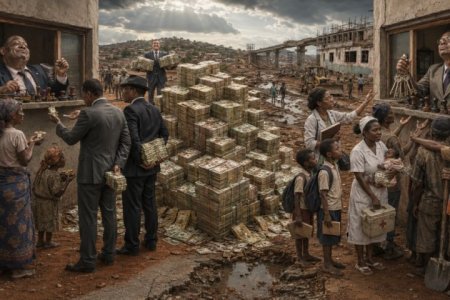
The 2026 budget execution figures in Madagascar reveal a shocking paradox that should be a national scandal: there is money in the coffers, voted budgets, signed financing agreements — and they are not being spent. Two billion dollars in external funding unexecuted, ministries operating at 2 or 3% commitment rates, treasury reserves swelling at the Central Bank while roads crumble. This is not a financing crisis: it is a crisis of state execution. First panel of a diptych — because this dysfunction combines with another, older one, to form a double scissors effect: a state that can neither collect nor spend. The problem is not particularly hidden. It is surprising that it raises so little debate.
Panel I — Money lying dormant, a state that no longer knows how to spend
Statement of facts
In the first quarter of 2026, according to the budget execution report from the Ministry of Economy and Finance itself, investments financed internally were executed at only 2.3%. The Ministry of Public Health dropped from a commitment rate of 40.3% to 2.9%… This is characterized near-paralysis. The Ministry of National Education, the Ministry of Interior also show near-zero commitment levels… and we wonder afterwards why things give the impression of inevitable and steady regression. We will not thank the previous government for having interrupted the semi-annual budget execution review for six successive years (which explains why these anomalies were not detected earlier)… We will congratulate this government for having restored it… A little transparency is not a luxury in this matter… The fact remains that halfway through the year, the state should logically have spent half its investment budget. Yet it has spent only a quarter: of 2,026 billion ariary planned, only 503 billion were actually committed to projects. And let no one tell us the coffers are empty: tax revenues are coming in at almost the planned rate, salaries are being paid, debt is being serviced. The money is essentially there… wtf? It is the decision to spend that is missing. As for donor money, the Finance Minister himself acknowledged in May: nearly 2 billion dollars already granted are lying unused — equivalent to more than an entire year of the country's tax revenues. And on World Bank projects, less than a third of available funds are actually spent. Absolute absurdity: we run around international summits begging for financing that we are then unable to absorb! We negotiate fiercely for envelopes that will sleep in designated accounts. It is no wonder that some say we can do without external aid… The constraint is no longer money. The constraint is elsewhere. But where exactly?
The bottlenecks are nonetheless clear, which at least identify what hampers spending capacity… Provided one wants to resolve them. What are they?
The state that always starts over and the spoils system
The first bottleneck is, in my view, the matrix of everything else: the lack of state continuity… discontinuity manifested three ways.
Through the destruction of instruments, first. The IMF noted this as early as 2022: the public investment management framework adopted in 2018 was already no longer being used, and the dismantling of the dedicated agency, OCSIF, had derailed even the finalization of the investment manual. A management tool was created… and then it was dismantled according to reorganizations… While promising to create another one. The Malagasy state, as is known, does not capitalize: it starts over. Through the interruption of routines, next. The semi-annual budget execution review, as noted above, had not taken place for six years. Six years! The Minister himself draws the obvious conclusion: that is why the anomalies were not detected earlier. For six years, nobody at the top of the state systematically compared what was programmed and what was actually achieved! Through the rotation of personnel, finally. Each reshuffle — the March 2026 one being the latest illustration — freezes signature delegations… resets validation circuits… and disperses case file memory. The "spoils system" characterizes the systematic practice of each political team coming to power redistributing administrative posts to its supporters… to its relatives… to its clients… The spoils system treats the administration as booty to redistribute, never as a memory to preserve. And obviously by removing appointees named by the previous team… and regardless of any consideration of competence… or worse still, of
Domestic
Neither collecting nor spending: Madagascar's state caught in a double bind
Source: Madagascar Tribune