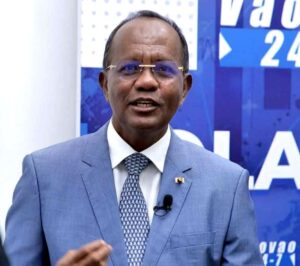
Rivo Rakotovao, national president of the Hery Vaovao ho an'i Madagasikara (HVM) party, has expressed concern over the appointment of fokontany chiefs. While the next elections are not scheduled until the second half of 2027, the strategic and political calculations of certain political formations are already stirring Madagascar's political class. Although direct election of fokontany chiefs was among the key demands of the protest movement in September and October 2025, the current government, through the Ministry of Interior and Decentralization, rejected the proposal as impractical in the immediate term. Administrative appointments were therefore favored instead. These appointments conceal behind-the-scenes maneuvers orchestrated by certain political actors seeking to pull the strings. "People are hesitant about the appointment of fokontany chiefs because most of them were at the origin of electoral fraud in Madagascar," said Rivo Rakotovao, national president of HVM.
Confidence Crisis
Remaining true to its critical stance, HVM positions itself once again as a force for proposals, demanding a comprehensive overhaul of electoral legislation before any new elections in the country. The party led by the former interim president also challenges the legitimacy of the Independent National Electoral Commission (CENI), the constitutionally mandated body responsible for planning and administering elections. "Since 2010, CENI has failed in its responsibilities," Rakotovao insisted, suggesting the institution either actively participated in various irregularities observed in the past or became complicit through guilty silence in the face of abuses. However, the HVM leader nuances his remarks by emphasizing that the problem goes beyond individual figures. "It is not the people who are the problem, but the system itself," he insists, while painting a bleak picture of a deep and persistent crisis of confidence between public opinion and the electoral body.
Instability
While praising ongoing parliamentary inquiries at the National Assembly, which he describes as an exercise in transparency under the banner of "Refoundation," he points to a troubling irony: the amnesia of deputies who were once silent about scandals under previous regimes. He particularly criticizes the catastrophic management of Jirama, the abandonment of road projects despite available funds in the Road Fund, and massive investments that yielded no benefit to the population. Regarding the upcoming legislative elections, Rivo Rakotovao proposes an audacious measure: strictly regulate, or even drastically limit, independent candidacies. According to him, their prevalence weakens institutional balance and fosters instability in the legislature. "With them, we cannot apply articles 70 and 72 of the Constitution," he laments, pointing to the excesses of political nomadism and the suppression of popular aspirations.
Finally, HVM reaffirms its total support for the demands of September and October 2025, calling for the outright dissolution of CENI and the National Assembly. While this objective enjoys unanimity within the party, Rivo Rakotovao acknowledges one point of friction remains: the timeline for these dissolutions. "What poses a problem is simply the timeline for these dissolutions," he concluded.