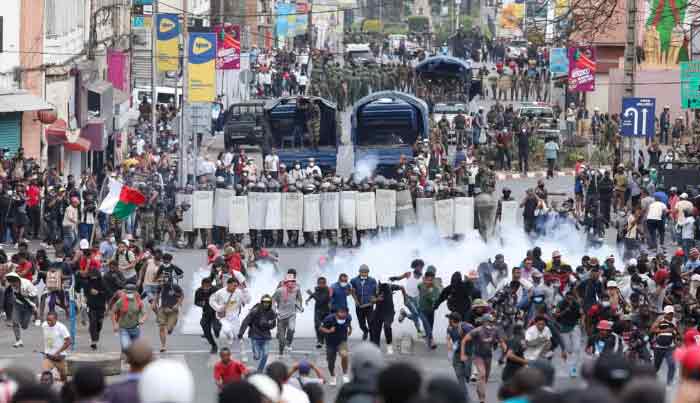
For a month between September and October 2025, streets witnessed clashes between security forces and young people. A year after the movement that led to the fall of Andry Rajoelina's regime, Gen Z initiators want to mark the first anniversary of their mobilization. A conclave is being prepared, while an online consultation is underway by Gen Z Madagasikara. A way to measure the distance traveled since Thursday, September 25, 2025, the date that marked the beginning of a sequence destined to transform the country's recent political history.
Almost a year ago, everything started with exasperation. On September 25, 2025, the first mobilizations of the movement called Gen Z emerged against a backdrop of endless electricity and water cuts in major cities. Initially, the demands were essentially social. Electricity was lacking. Water was lacking. Anger was not. But in the streets, the movement quickly gained new dimensions. After several weeks of mobilization, the protest went beyond power cuts and water shortages.
In the capital, young people were joined by a significant portion of the population. The movement grew while authorities hardened their response. Security forces intervened to contain the mobilization. Confrontation ensued. Then came October 2025. And with it, the turning point. The position taken by a faction of the military from Capsat, led by Colonel Michael Randrianirina, gave the crisis an entirely different scope. Within days, the political balance of power was reversed. Andry Rajoelina's regime collapsed. The former president left the country on October 12, 2025, amid acute political crisis. On October 14, a new military-led government was installed with the intervention of the High Constitutional Court. A new chapter in Malagasy political history opened and promises of "refoundation" emerged.
Paradoxically, the regime's fall did not mean the end of Gen Z. Young people who had contributed to the movement's emergence gradually stepped out of the shadows. Some chose to join the new power structures. Others distanced themselves, preferring to maintain their freedom of speech and critical position. The movement itself now seeks to redefine itself. The transition from street to institutions is neither automatic nor without contradictions.
It is in this new configuration that the commemoration of the first anniversary of September 25, 2025 is being prepared. Gen Z Madagasikara is currently organizing a conclave to mark this symbolic date. Beforehand, an online consultation has been underway for several days to gather opinions and proposals around this meeting. A year later, the movement wants to look in the rearview mirror. But not only that. Behind the commemoration of a foundational day looms a heavier question: what remains of the momentum of September 25, 2025 in the new Madagascar that emerged from the October crisis?
The first anniversary could thus be less a ceremony of remembrance than a moment of clarification. Between those who joined the government and those who chose to stay at distance, between the street's momentum and the demands of power, Gen Z now confronts its own history. A history that, in less than a month, had transformed anger over water and electricity cuts into a major political crisis. And which, nearly a year later, still seeks to know what it wants to become.