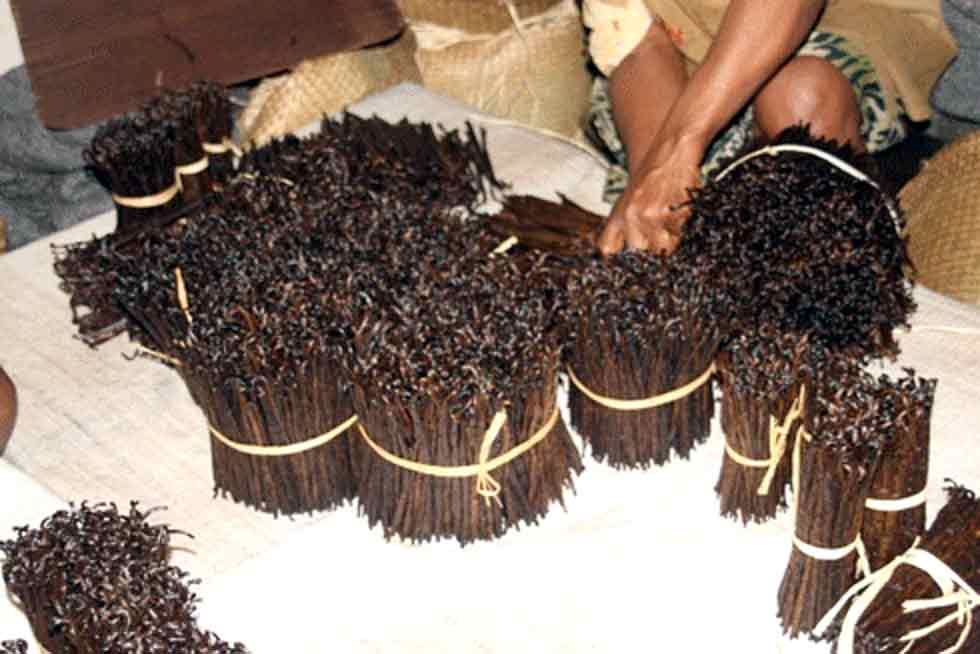
Madagascar must first and foremost maintain the quality of its vanilla. A return to managed markets. The government has decided to set a minimum price for green vanilla: 5,000 ariary for short varieties and 10,000 ariary for long varieties. In theory, this interventionist measure, decided at the Council of Ministers last Wednesday, is intended to resolve, at least temporarily, the problems of falling income for farmer producers.
Market imbalance
Indeed, while these are not yet acceptable prices for farmers, the 5,000 and 10,000 ariary will allow them some relief. Just a few weeks ago, their production was selling for between 1,000 and 2,500 ariary per kilo in certain production zones. A measure aimed at protecting producers against a sharp drop in their income. On the face of it, this is a commendable solution intended to protect the interests of growers. However, questions arise about the real effectiveness of this measure, for the simple reason that the current weakness in prices does not result solely from a malfunction of the national market. It is above all a consequence of an imbalance in the international market. For several years, vanilla stocks have accumulated both in Madagascar and among foreign buyers. At the same time, global demand has contracted, particularly following the exceptionally high prices recorded between 2017 and 2019, which led many industrialists to reduce their consumption of natural vanilla or turn to substitute products.
International market
For some vanilla sector operators, the most effective solution would be to act directly at the international market level, by maintaining or even improving the quality of Madagascar vanilla while practicing competitive prices compared to competing countries. In short, the authorities, in collaboration with sector stakeholders, must find solutions to convince international industrialists to increase their purchases of Malagasy vanilla. Some operators also believe that implementing the use of 4 dollars per liter of vanilla collected by the former National Vanilla Council, renamed Alliance de la vanille de Madagascar (AVM), may not be effective in the long term. Indeed, this solution could only absorb around 600 tonnes of stocks out of more than 3,000 tonnes remaining on the market. A solution that could also be a source of corruption. "The State must demonstrate transparency in the use of this fund," operators argue.
Economy
Vanilla sector: State sets minimum price of 5,000 and 10,000 ariary per kilo
Source: Midi Madagasikara