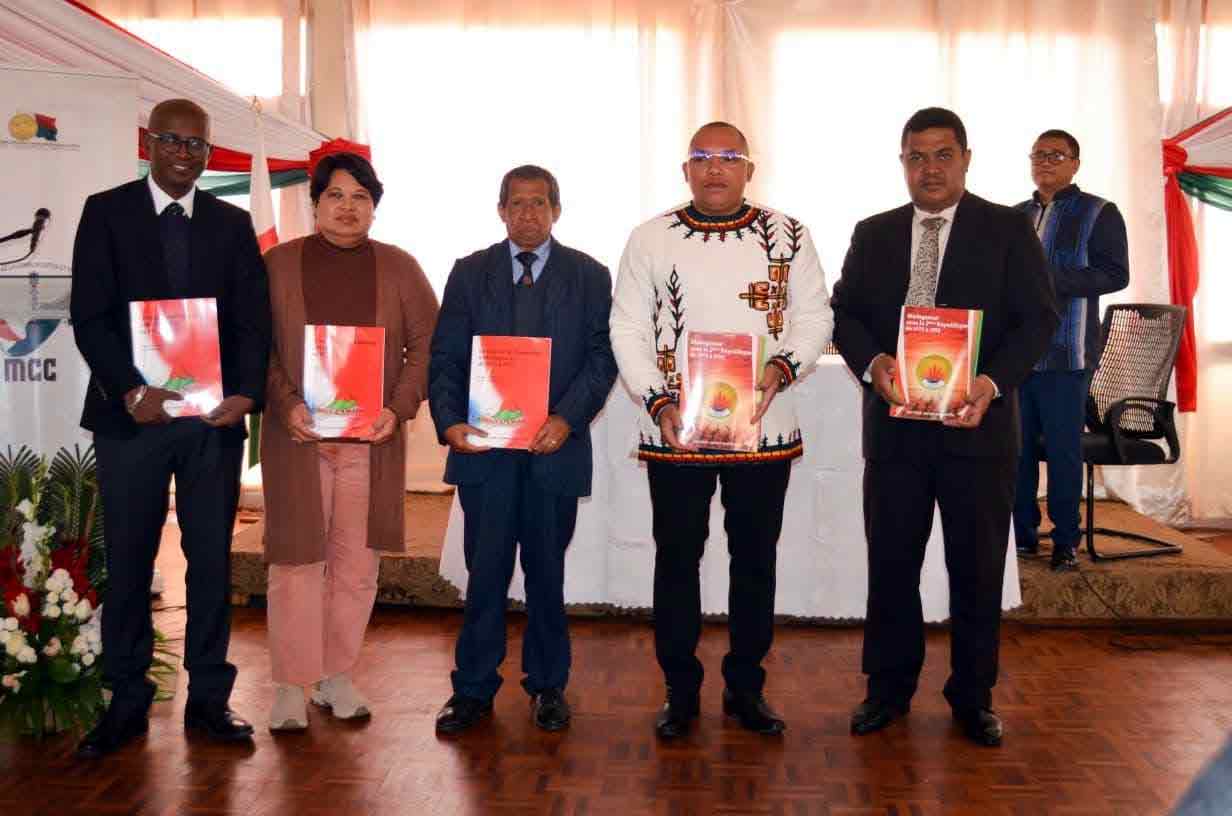
Designed by Prof. Jeannot Rasoloarison and Dr. Denis Lahiniriko, this 48-page book offers high school students the historical keys to understanding the present. Complementing previous volumes on colonization and the First and Second Republics, the new work on the 1972 Transition has just been released, providing essential historical insights for better comprehending current events. As Madagascar navigates turbulent transitional waters once again, historians are turning to the past to illuminate the present. In this context, Professor Lalasoa Jeannot Rasoloarison and Doctor Denis Alexandre Lahiniriko have published, under Éditions Jeunes Malgaches, a crucial work titled "The Transition Regime in Madagascar from 1972 to 1975." The 48-page A4 format book features a caricature by Max Razafindrainibe on its cover, tracing the dynamics of the Great Island's first transition following President Philibert Tsiranana's fall.
Striking Parallel
For Professor Jeannot Rasoloarison, this work primarily fulfills a duty of memory and scientific outreach. "This book highlights the actors who led the country during this pivotal period. There were military personnel, but also civilians who collaborated to design a policy breaking with the previous colonial system," he explains. This analysis is shared by co-author Doctor Denis Alexandre Lahiniriko, who draws a striking parallel between yesterday's aspirations and contemporary realities. "History seems to stutter. When we speak today of 'Refoundation,' we forget that this concept, and approaches like 'Zaikabe,' were already central to the first transition," he notes, lamenting that forgetting the past condemns the country to cyclically reliving the same crises. The objective is clear: transmit this knowledge to youth often ignorant of this era, giving them keys to understanding the present.
Recurrent Pitfall
One major lesson from this historical research concerns managing popular demands. Dr. Lahiniriko warns against a recurring pitfall: "During demonstrations, people are heard, but once the Transition and new regime are established, initial expectations are often forgotten or diverted." For genuine refoundation to succeed, power must anchor itself in sustainable responses to the population's real needs. Prof. Rasoloarison recalls that youth has always been the engine of change. If students rose in 1972 demanding Malagasy language education, causing the First Republic's fall, recent 2025 events in Madagascar show youth remains the catalyst for popular aspirations. The 1972 transition power attempted materializing these expectations through major gatherings—a lesson in responsibility the authors deem essential for current generations.
Solemn Ceremony
The book's release coincided with a solemn ceremony. Communication and Culture Minister Ogascar Fenosoa Mandrindrarivony elevated both researchers to Commander of the Order of Malagasy Arts, Letters and Culture. Congratulating the authors for this timely publication, the minister recalled two well-known adages: "He who ignores history resembles an amnesiac. History serves as lesson and mirror for the path ahead." To make this historical mirror accessible to the widest audience, the authors announced broad distribution in capital bookstores and throughout the island's regions. An essential academic and civic tool as Madagascar seeks its way forward.