Domestic
Northern Livestock: Between Conservation and Challenge
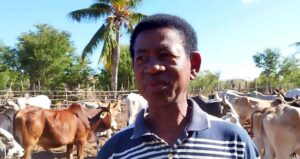
Monsieur Ludovic is convinced that contemplative livestock farming no longer generates income. Brahman bloodline is unmistakable in Monsieur Ludovic's herd at Bitahitry, in Diego II district. At first glance, the difference is striking. The build and size of the animals reflect the heritage of this breed introduced to Madagascar between 1950 and 1960, aimed at improving the performance of the Malagasy zebu. Yet results depend on more than genetics alone. These imposing animals require rigorous livestock management. This represents considerable effort, conducted methodically, in an intensive approach that contrasts with the sometimes static image of herds left to fend for themselves in pastures. Zebus must be monitored, fed, and watered. This is precisely Monsieur Ludovic's passion. "Their health status receives regular attention. This requirement is all the more important as northern livestock farming operates in an environment where natural conditions are becoming increasingly unpredictable," he testifies. Institutional support takes on full meaning here. This quality herder benefits from support from the Ministry of Livestock through the Regional Livestock Directorate, DIREL-DIANA. Technicians regularly visit his farm to monitor herd health, provide advice suited to field realities, and supply necessary veterinary products. This presence is no luxury for the herder. It represents security in a sector where disease, poor nutrition, or prolonged drought can quickly compromise years of work. Dr Etienne Fenozandry, regional director of livestock for the DIANA region, visited Bitahitry. Livestock at the heart of the North's economy The zebus of Bitahitry reveal a much broader reality. Pastoral life holds considerable importance in the economy. Considered a wealth since time immemorial, the aomby represents above all a family heritage and economic reserve, even a social marker. Herd ownership is therefore not measured solely in kilograms of meat or market value. It reflects patient accumulation, passed from generation to generation. But this living heritage now faces a new equation. Climate is changing, and herders measure the consequences without needing statistics to observe them. Seasons become less predictable, dry periods may lengthen, water sources become scarce, and pastures lose their capacity to properly feed animals. The breed remains. Water becomes the central question. In certain northern zones, animals can no longer drink adequately. Watering points become insufficient and irregular. Yet a herd cannot maintain productivity without regular access to quality water. An animal that walks further to reach water expends energy. The herder thus faces a contradiction: he possesses livestock capable of producing more, but his environment no longer guarantees the necessary conditions for expressing this potential. This is where climate disruption ceases to be conference rhetoric. It becomes reality in the pastures. Bitahitry, over a decade, loses its greenery. Genetics, the herders' other battle The challenge does not stop at water. Genetic management constitutes another concern. The Malagasy zebu possesses remarkable adaptation capacity to its environment, but herd management sometimes poses the problem of inbreeding. When breeding animals come too often from the same family nucleus and exchanges between herds remain limited, the risk of mating between related animals increases. Over time, this situation can reduce genetic diversity and weaken herd performance. "The question is all the more strategic as Malagasy livestock farming seeks precisely to improve animal productivity. Introducing breeds or lines presenting certain qualities can provide answers regarding growth, conformation, or resistance. But genetic improvement cannot be reduced to crossing two animals and awaiting results. It requires reasoned selection, monitoring of breeding animals, and knowledge of the herd," explains Dr Étienne Fenozandry, regional livestock director. Without this mastery, the sought improvement can itself become a source of difficulties. Monsieur Ludovic's experience thus illustrates a transformation.
Source: Midi Madagasikara