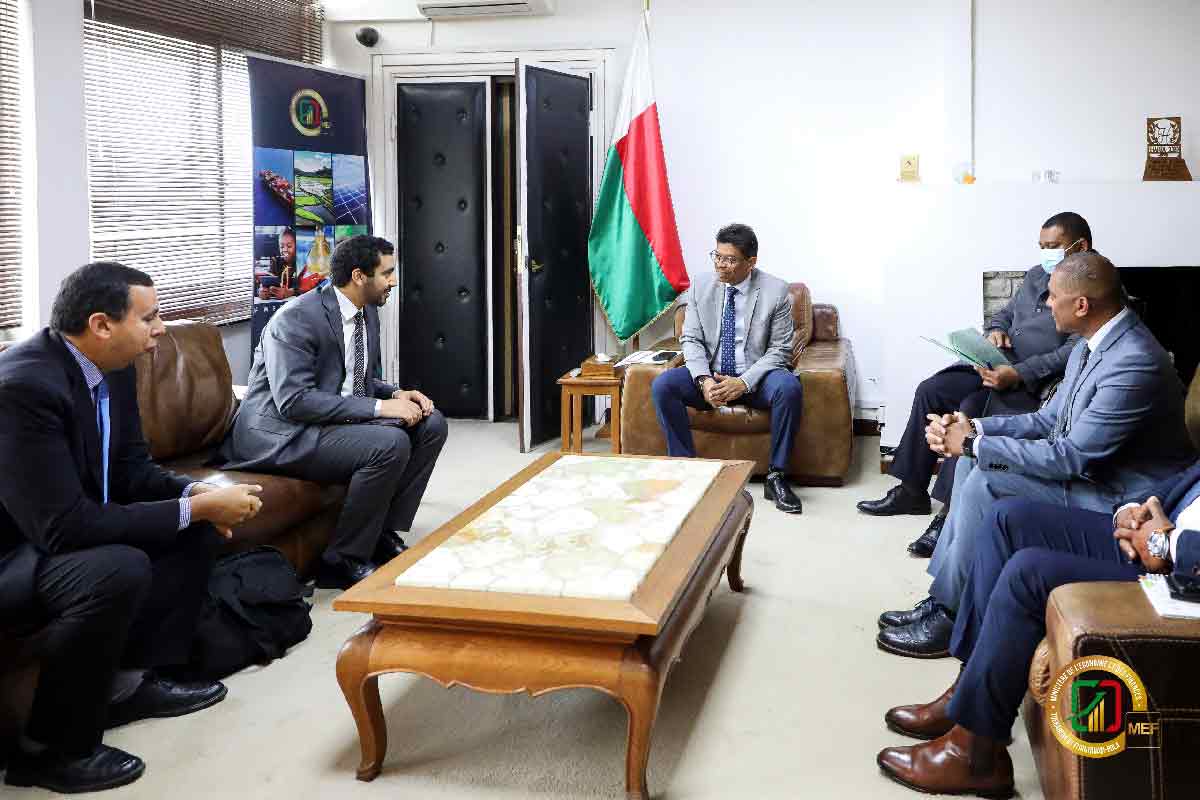
A BADEA delegation was received yesterday by Finance Minister Dr Herinjatovo Aimé Ramiarison at the Ministry of Economy and Finance in Antaninarenina. The delegation is in Antananarivo to assess the second phase of RN5 development between Vahibe and Mananara-Nord. During the meeting, the institution indicated it is considering a contribution of $40 million.
Between Vahibe and Mananara-Nord, the rehabilitation of RN5 is imperative, extending beyond its role as a construction project. This road must further open Madagascar's Northeast to trade, markets, and investments. These issues formed the basis of yesterday's discussions between the Finance Minister and the BADEA delegation (Arab Bank for Economic Development in Africa), which is on a mission to Madagascar.
The visit comes as the project enters a decisive phase. BADEA has announced a planned contribution of $40 million to finance the second section of RN5, between Vahibe and Mananara-Nord. The evaluation mission, scheduled for August 17-20, will examine the technical, economic, financial, and institutional components of the project before finalizing next steps.
The updated cost of this second phase is estimated at $147.389 million. Several Arab partners are being approached for financing, including BADEA, the Saudi Development Fund, OFID, the Kuwait Fund, and the Abu Dhabi Fund. Three have expressed interest so far, with BADEA committing $40 million.
For the Malagasy government, RN5 is a strategic axis for opening up isolated regions. The first phase, connecting Soanierana-Ivongo to Vahibe, already benefits from BADEA financing of $10 million. The institution is also participating in other major infrastructure projects, including the Mangoky bridge with $20 million, as well as the Anosizato fly-over and Maki roundabout projects.
Discussions extend beyond the road sector alone. Madagascar also presented BADEA with several priority projects in agriculture, energy, and major infrastructure. These include the GRACIR project to strengthen agricultural resilience, the Volobe hydroelectric project, and the Antananarivo-Toamasina highway. On the latter, a grant of $1.484 million was already signed in July to finance an integrated feasibility study.
Yesterday's meeting reflects both parties' commitment to accelerating the transformation of financing into concrete projects. For Madagascar, the challenge now is to make this cooperation directly beneficial to mobility, economic activity, and territorial development.