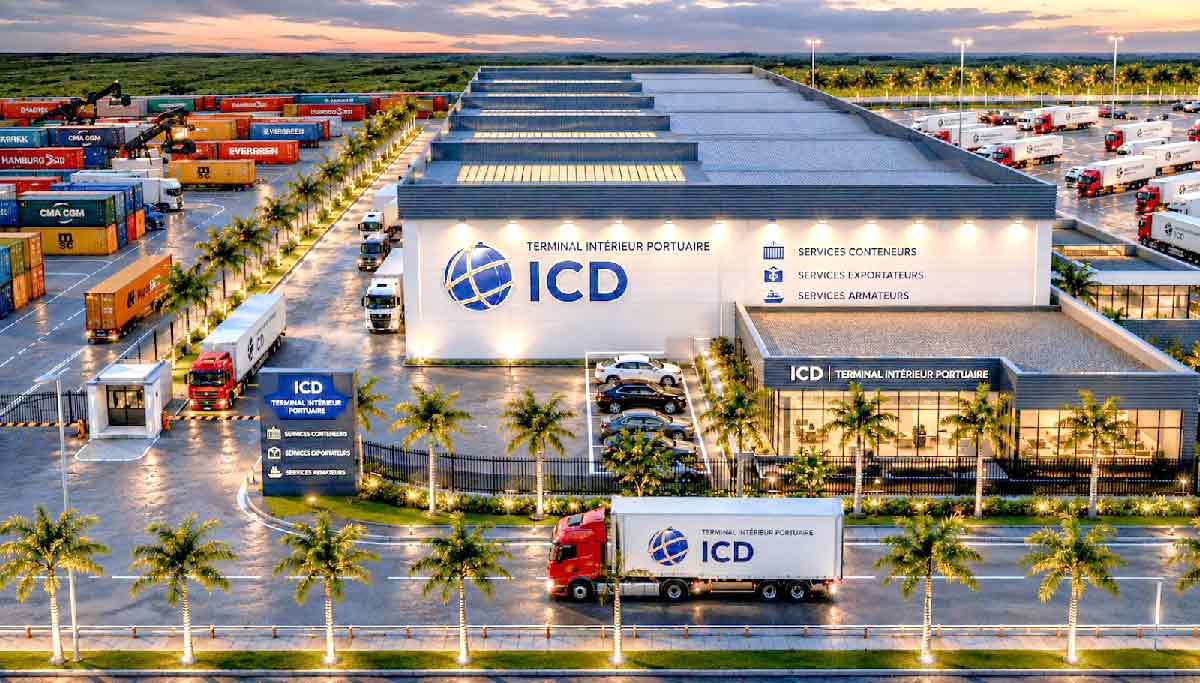
The ICD, a future symbol of modernization and port performance for the country. The Multimodal Logistics and Port Platform of Toamasina (PMLP-T) is moving forward. Its first pillar rests on establishing an Inland Container Depot (ICD), also called a dry port or inland container depot. One of the ICD's objectives is to serve as a tool for relieving congestion at the country's port terminal.
Extension
Located outside the main port terminal, the ICD enables several container-related operations. These include reception, storage, customs clearance, consolidation and deconsolidation of goods, as well as their repair and repositioning. Within the PMLP-T framework, the ICD will thus constitute a true inland extension of the Port of Toamasina. An infrastructure that arrives at the right time to end container backlogs that have been a major problem in port management. Indeed, the development of trade and port activities exerts increasing pressure on Toamasina's logistics infrastructure. In 2025, more than 95,318 empty containers were recorded in Toamasina, while 280 to 350 trucks circulate daily on the logistics corridor connecting the city to the rest of the country. These volumes illustrate the need to better organize the flow of goods, containers and vehicles around Madagascar's main port. By transferring certain activities to a dedicated logistics space, the ICD will allow better utilization of port capacities, improve container rotation and streamline operations. The challenge is to make the terminal, above all, an efficient transit space rather than a prolonged storage facility.
Intermediate Logistics Point
Transporters will also benefit from the ICD's advantages. Indeed, with up to 350 trucks circulating daily on Toamasina's logistics corridor, managing heavy vehicle movements is also a major issue. The ICD will offer transporters an intermediate logistics point for depositing, handling and repositioning containers. Better programming of movements will thus limit unnecessary circulation, reduce waiting times and prevent all operations from being concentrated around the maritime terminal. In short, all Grand Port users, such as importers, exporters, freight forwarders, customs brokers, transporters and shipowners, will benefit from a better organized environment for their operations. By grouping several logistics services on the same platform, the PMLP-T will simplify procedures, improve operational predictability and strengthen supply chain efficiency.
SPAT 2.0
The ICD will also be designed as a secure, structured and digitalized space. Digitalization of procedures will facilitate container tracking, goods traceability and information exchange between different actors. Beyond addressing current constraints, the PMLP-T prepares the Port of Toamasina for future traffic evolution. The development of port infrastructure must indeed be accompanied by sufficient logistics capacity to absorb increased flows without increasing pressure on the terminal and road networks. Through this first pillar of the PMLP-T, SPAT continues implementing the SPAT 2.0 vision: making the Port of Toamasina a more modern, efficient, competitive port better connected to Madagascar's economic needs.