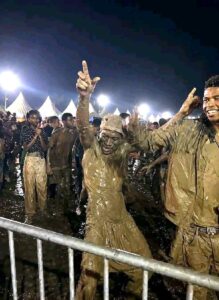
Festivities organize themselves across the island during the long holidays, as they do every year. Posters multiply, stages are erected, and artists take over public squares. The officially stated objectives usually boil down to a few words: "Promote local culture and attract tourists, whether national or foreign." From another angle, festivals also serve a less acknowledged function: entertaining the people. Organizers rarely highlight this argument, yet distraction occupies a central place in these gatherings. Entertainment or distraction—the interpretation remains open. The State sometimes plays the role of a patron, so to speak. It provides support while maintaining an apparently neutral position. However, the festival can become a convenient means of momentarily diverting attention from daily difficulties. A principle that is hardly new. From Greco-Roman history to accounts of ancient Malagasy kingdoms, spectacle has often accompanied the exercise of power. When the people watch the stage, they watch less of what happens elsewhere.
Proposing recreational activities is not condemnable in itself. They allow people to gather for a few days and forget their worries. Music, dance, and performances offer the respite everyone may need. But the respite always ends. After the last song, the lights go out and everyone returns to their daily life. Meanwhile, concerns remain. When the festival becomes permanent, the risk is transforming distraction into collective anesthesia. The citizen dances today, only to face tomorrow the same problems they tried to escape hours earlier. Yet we must be careful not to condemn festivals outright. The organizers, even when pursuing commercial interests—which remains understandable in a competitive sector—also seek to promote their localities. Most project creators work in good faith. A well-conceived celebration gives visibility to a region, valorizes its artists, attracts visitors, and can even sustain an entire local economy. When those in power get involved, the festival changes nature. Leaders then set the festivities ablaze. The ceremony no longer merely entertains; it becomes a way to make opinion dance to the rhythm of current interests.
The festival claims its place. Over the past thirty years, cultural events have taken on another dimension. Gatherings testify to an increasingly marked attachment to what makes a territory unique. Thus, identity claims enter the picture. From North to South Madagascar, "human groups" highlight their traditions, languages, histories, and symbols. The stage becomes a place of recognition. Fanamby Rasamoely, a cultural anthropologist by training, believes art is precisely a privileged means of reclaiming one's belonging. "In fact, politics merely follows. Art, culture in general, begins the struggle," he affirms. An assertion worthy of reflection, since claims can begin on stage. The artist does not necessarily brandish a slogan. Rather, they show who they are. The anthropologist considers art a form of contestation that can prove effective. "It takes at least a quarter century for the population to realize that stage directors, playwrights, and event entrepreneurs played a primordial role in this identity construction," he concludes.
The festival is therefore never entirely innocent. It can also remind a population of its roots. The line between distraction and claim is thin. It ultimately depends on who writes the script and those who watch with admiration.