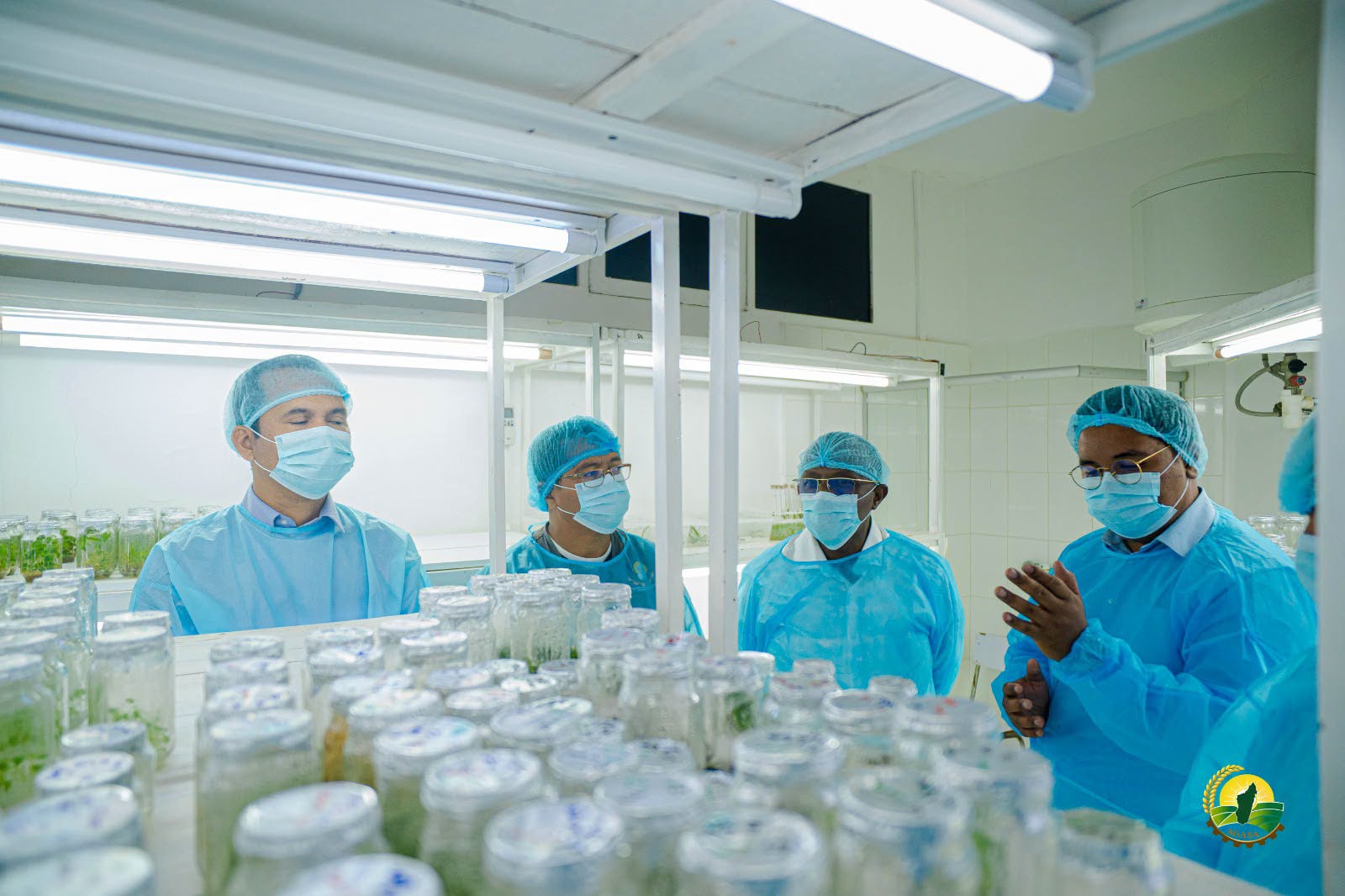
A ministerial delegation visited the K-Agri plant biotechnology laboratory in Ambatolampy Tsimahafotsy. Madagascar aims to revive its coffee sector, which once brought international renown to the island nation. In the 1990s, the Grande Île ranked among the world's leading coffee exporters, holding 3rd place in Africa and 18th globally. Annual production then reached around 80,000 tonnes. Today, due to severe sector decline, output has plummeted to just 15,000-20,000 tonnes. The Ministry of Agriculture and Food Sovereignty now seeks to modernize coffee plantations to restore the sector's international standing, meeting both local demand—currently filled by imports—and global market needs.
Public-Private Partnership
To achieve this, a partnership was established between the ministry, through the Official Seed Control Service (SOCS) and FOFIFA research center, and the Robens group, specializing in plant biotechnology and industrial micropropagation production. This collaboration aims to modernize the sector through plantation renewal. Using plant biotechnology, the project will provide large-scale vigorous young plants, disease-free, high-yielding, and adapted to production zone soil and climate conditions. Under this public-private partnership (PPP), the ministry plans to renew 100,000 hectares of coffee plantations by facilitating producers' access to higher-performing seeds. "Developing a robust national seed system relies on complementarity between state capacity and private sector expertise. Strengthening this partnership must increase availability of quality seeds adapted to different agroecological zones, supporting sustainable agricultural production growth," emphasized Agriculture Minister Gaëtan Ramindo.
Better Seed Access
Moreover, seed availability represents a strategic priority enabling producers to improve yields, harvest quality, and farm resilience against climate variability. "To support the agricultural production scaling sought, the challenge also involves capacity to produce and distribute seeds in sufficient quantities, through appropriate technologies and efficient distribution chains," he continued. A delegation led by the minister then visited the K-Agri plant biotechnology laboratory of the Robens group, located in Ambatolampy Tsimahafotsy. This visit reflects government commitment to consolidating the private sector's role as strategic partner in the national seed system. It aligns with broader efforts to revive major agricultural sectors, particularly coffee, maize, rice, and counter-season crops. "This partnership strengthening should ultimately offer producers better access to high-performing, adapted seeds. This is essential leverage for stimulating agricultural productivity, strengthening national production capacity, and enabling sector scaling," he concluded.
Economy
Coffee Sector: Modernizing Coffee Plantations Through Plant Biotechnology
Source: Midi Madagasikara