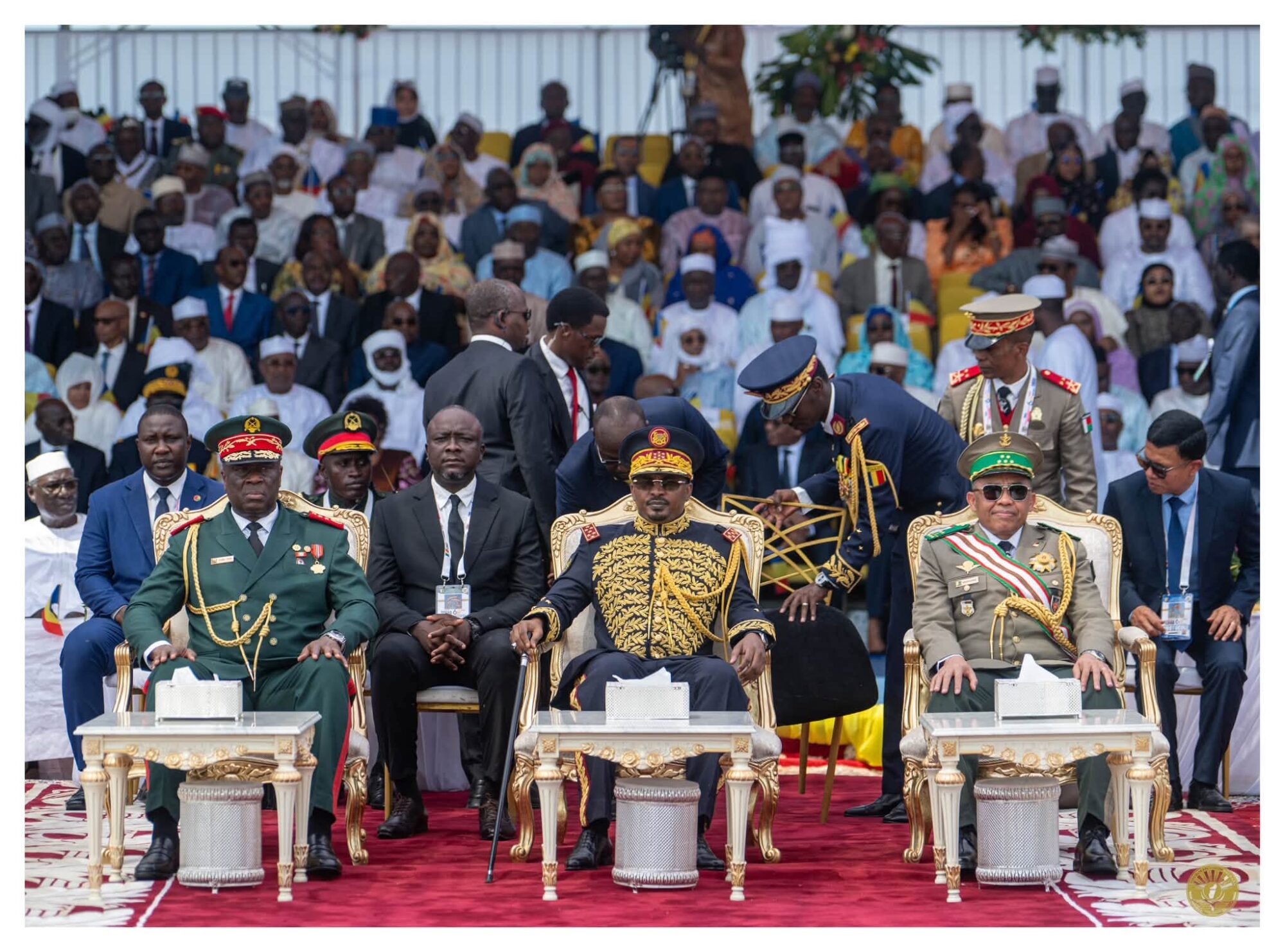
Colonel Michael Randrianirina with his counterparts from Guinea-Bissau (left) and Chad (center). Following visits to Chad, Egypt, Gabon, Republic of the Congo, Equatorial Guinea, Michael Randrianirina's African diplomatic travels reveal a pattern: military-origin leaders who came to power through constitutional breaks occupy a prominent place. Michael Randrianirina returned to Madagascar early Wednesday morning after concluding his official visit to Chad. In N'Djamena, he met Marshal Mahamat Idriss Déby Itno, the Chadian leader who came to power in 2021 heading a military transition council following his father Idriss Déby's death. The Malagasy president and his Chadian counterpart notably expressed their commitment to strengthening relations between the two nations. The meeting took place during Chad's independence celebrations, attended by other African leaders. "If Africans strengthen their relations, Africa should find its salvation," Michael Randrianirina declared after the trip, calling on Africans to remain united to advance the continent. He also assured that relations between Madagascar and Chad could now reach a new level after years of diplomatic ties without genuine summit meetings.
Behind the handshakes, communiqués, and cooperation promises, one pattern stands out: the profile of African leaders the "refoundation" chief chooses to meet. A diplomacy first looking toward the barracks: Chad, Gabon, Republic of the Congo, Equatorial Guinea, Egypt. The list is revealing. Repeatedly, Michael Randrianirina has favored leaders with particularly marked military backgrounds, some having come to power through coups or constitutional breaks, then maintaining control. In Gabon last June, he met General Brice Clotaire Oligui Nguema, who came to power after Ali Bongo's overthrow in August 2023. In Chad, he was received by new Guinea-Bissau leader General Horta N'Tam, installed heading a military transition after the November 2025 coup that interrupted the electoral process. The military had taken control on the eve of presidential results announcement.
Turning Point
In Chad, the case differs but remains within military power logic. Mahamat Idriss Déby took the country's helm following his father's death with a military transition council's support, before becoming president. In Republic of the Congo, Michael Randrianirina already met Denis Sassou-Nguesso last May. The Congolese leader returned to power by force in 1997, having previously seized it through a 1979 coup. In Equatorial Guinea, Colonel Michael Randrianirina also met Teodoro Obiang Nguema Mbasogo last March, ruling since 1979 when he overthrew his uncle Francisco Macías Nguema in a military coup. In Cairo last month, Michael Randrianirina met Abdel Fattah al-Sissi, former army chief turned president after Mohamed Morsi's 2013 removal. During that visit, the Malagasy leader called Madagascar-Egypt relations a "historic turning point."
Taken separately, each trip can be justified by diplomatic, economic, security, or geopolitical considerations. No state chooses partners solely by political history. But combined, these meetings produce an image hard to ignore. Michael Randrianirina's African diplomacy appears to grant particular attention to military-apparatus leaders and regimes born from political breaks. Multiplying meetings with military or former military chiefs turned presidents can produce a political signal itself. Michael Randrianirina himself came to power following a political and military break. In this context, his visits to leaders with comparable trajectories take particular dimension. They can be presented as building new African solidarity, freed from old tutelage and founded on common interests. But they can also be interpreted as progressively constituting a proximity network between military-origin powers or rupture transitions.
Politics
African Diplomacy: Michael Randrianirina Moves in Military-Backed Leadership Circles
Source: Midi Madagasikara