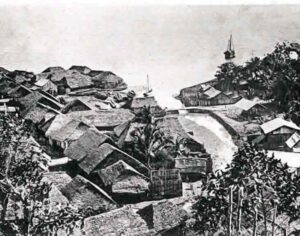
The prosperous trading post of Nosy-Be. Traces from the 10th to 12th centuries remain present in Marodoka, an ancient commercial trading post of Nosy Be. Vestiges and heritage are preserved there, bearing witness to a period when the island was already at the heart of exchanges in the Indian Ocean. It was in this neighborhood rich in memory and history that a delegation led by the Minister of Culture and Communication, Gascar Fenosoa, traveled during his visit to the Perfumed Island. Several heritage sites were visited, notably the House of Ghosts, the Indian House, the location of Nosy Be's first distillery as well as the first mosque. Different places, but each serving as landmarks to understand the different stages of the island's history.
After Tsiomeko, Queen Binao made the Perfumed Island flourish. An island open to the Indian Ocean. Marodoka holds a particular place in history. The neighborhood bears witness to ancient contacts between several communities of the Indian Ocean. The Sakalava kingdom of Bemihisatra maintained relations with African populations along the Mozambique Channel, with Arabs and Indians. Places of worship, customs and traditions still bear the marks of these relationships and influences. The architectural heritage thus recalls that Nosy Be was built at the pace of commercial exchanges and circulation between the different shores of the Indian Ocean. But the history of Marodoka is not only that of these old stones ingeniously stacked. It is also transmitted through customs, clothing styles, cultural practices, traditional trades, know-how, culinary arts and especially oral literature. This intangible dimension gives meaning to the buildings and preserved places. A house, a mosque or an old industrial installation tell a historical story. Practices allow us to understand their significance. Preserving Marodoka means protecting both what is visible and what is transmitted. Through this approach, the ministry intends to strengthen the promotion of Nosy Be's historical and cultural sites to better ensure their preservation. This heritage appears as a link between several cultures and generations.
The Mozambique Channel was, in a sense, a "dhow highway" from the 10th century onward. From Bagamoyo to Marodoka. Trading post, supply point, cultural crossroads, the western part of the Great Island, thanks to the Mozambique Channel, once had cities animated by commerce. The capital of the Sakalava kingdom of Bemihisatra was a great city and a mandatory passage for foreigners long before the 10th century. It was also linked to the slave trade. This open gateway witnessed the arrival of slaves from the Tanzanian coast, particularly from Bagamoyo. Located about a hundred kilometers north of Dar-es-Salaam, this city was once an important settlement in East Africa. Over time, Bagamoyo lost its importance and became a small town. Its name may come from "Bwaga moyo," a Swahili expression meaning "abandon your heart." An expression that refers to the despair of those captured to be sold as slaves, facing an uncertain future. According to writings, "Bagamoyo was the arrival point for porters and captives who crossed the country from Lake Tanganyika, even from neighboring territories." Regional historians specializing in the area suggest that slaves arrived there on foot or in caravans. They were sold, exchanged and then sent to islands of the Arabian Peninsula or Persia, but also to the New World. For many, Bagamoyo represented a point of no return. Some of these captives were later transported to Marodoka. The name of the neighborhood would be the union of two words: "maro," in Malagasy, meaning "several," and "duka," a Swahili term derived from the Arabic "dukan," associated with commerce. The turtle-shaped island was among Madagascar's ancient ports. Dhows from South Asia, Mayotte, and the Comoros made stops there. These relationships with foreign populations contributed to the mixing of inhabitants. Swahili and Malagasy were spoken there, testifying to the intensity of exchanges in this part of the Indian Ocean. In the following century, despite the abolition of the slave trade, it continued clandestinely in the region. Arabs notably hunted Black "Makoa" and boarded them on dhows to sell them to South Asia. The northwest coast of the Great Island was a hub of the slave trade.