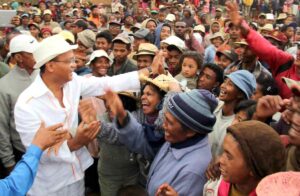
The ADN party leader had undertaken 'A Tour of Madagascar in Three Years' with 'Grassroots Reconstruction – Appropriate Federalism'. This is the title of the book written by ADN party founder Edgard Razafindravahy and his team, following months of reflection and synthesis of field research, or 'fidinana ifotony', across the entire country. A form of brainstorming consistent with this organization's particular conception of political authority, which does not have power concentration in its DNA. This explains why there is no national president, but a party leader heading this political formation affiliated with the Liberal International and endorsed by the Danish Liberal party Venstre. Presented on March 7, 2017, the 161-page work reflects the vision and approach of its main author, who was ahead of his time regarding current debates on refoundation in general and federalism in particular. The title itself is a summary, even a preview, as this is neither an adventure series nor Jules Verne-style science fiction. Unlike the famous French writer who recounted 'Around the World in Eighty Days', Edgard Razafindravahy, with his work now regaining popularity, draws inspiration from what he actually saw, experienced and heard during his three-year tour of Madagascar. A grassroots approach for this man of conviction, whose book could illuminate current federalism debates and even refoundation discussions.
Appropriate Political System
As Madagascar questions the form of its State anew, a doctrine developed years earlier by the ADN and Edgard Razafindravahy regains full meaning and essence. Behind 'Grassroots Reconstruction – Appropriate Federalism', it is not merely about demanding federalism: its designers had imagined true reconstruction of the Malagasy State from the ground up. The debate seems new. Yet it is not for everyone. Unitary State or Federal State? While the question of State form now enters the Refoundation process, Madagascar's political microcosm rediscovers a subject long kept at the periphery of major national debates. For the ADN, however, this question is not new. The book 'Grassroots Reconstruction – Appropriate Federalism' testifies to this, proposing genuine ideas about State form or 'appropriate' political system. At first glance, the concept might be grouped among various federalist demands that have marked Malagasy political history. Yet this would miss its particularity. For 'Appropriate Federalism' proposes not only transforming Madagascar into a federal State. It proposes reconstructing the Malagasy State from its foundation. Change regime or change system? This is probably the first rupture proposed by this doctrine.
State Architecture
Since independence, Madagascar has experienced different political systems: strong presidency, reinforced Parliament, institutional rebalancing, decentralization, new Republics and constitutional revisions. For 'Appropriate Federalism' authors, these changes would not have addressed the real problem. They modified the regime without sufficiently modifying the system. 'Successive leaders changed the form of power within the same state architecture. The proposal therefore consists not simply of correcting this architecture, but of reconstructing it'. This is where 'Grassroots Reconstruction' takes meaning. Literally: 'rebuild from the foundation'. Appropriate Federalism The principle posed is radically different from simple administrative deconcentration: 'power must originate from the fokonolona and rise toward the State, rather than descend from central power to the population'. This is explicitly one of the principles stated in the project. A federalism that refuses to copy anyone. The second doctrine element lies in the word 'sahaza', meaning 'appropriate' or 'adapted'. The work studies foreign federal experiences but refuses to make them mechanical models to reproduce. The annexed document reaffirms that foreign systems can provide lessons but should not simply be copied. The book also distinguishes between federation and confederation. Madagascar would remain a single State. Its component entities would have political and institutional autonomy, but not sovereignty permitting independence. The text thus speaks of regions capable of self-administration without becoming independent States.
Domestic
Edgard Razafindravahy: 'Grassroots Reconstruction – Appropriate Federalism', a visionary state model
Source: Midi Madagasikara