Domestic
Federalism: Daring to speak the unsaid
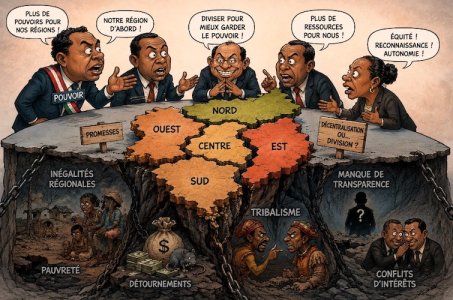
Social media has become a place of passionate debate among Malagasy citizens about federalism. This is both good and bad news. The good news is that citizens' enthusiasm for expressing themselves on important matters that concern them represents a healthy form of political participation. The bad news is that the way the subject is being debated shows the risk of the discussion derailing. One must acknowledge this point: many reasons cited by federalism supporters are not illegitimate, quite the opposite. There are indeed so many incongruities in public administration mechanisms that highlight the limitations of the unitary model. How can we accept that important decisions for local communities are made in Antananarivo? How can we understand the waste of public money on frivolities in Antananarivo (Barea stadium, Coliseum at Rova d'Antananarivo, water fountain shows at Lake Iarivo, etc.), while famine was causing human tragedies in southern Madagascar? After 66 years of republican independence, development gaps between regions have sharpened frustrations. These encourage the frustrated to believe that the unitary structure favors the Capital, though often with irrational viewpoints prone to shortcuts. All wealth and resources (ports, minerals, etc.) would be in the regions, but it is Antananarivo that benefits. There would be a deliberate effort to organize the underdevelopment of other regions to favor Antananarivo. Very quickly, the name Antananarivo takes on another meaning in certain mouths. People say Antananarivo, but they mean Merina. Of course, these voices deny it. Federation of unsaid things The federalism debate is indeed surrounded by many unspoken matters, even hypocrisy, with many advancing arguments as a facade to justify their position for or against federalism, without ever daring to address the true foundations of their opinion for reasons of political correctness. The subject thus feeds two pretexts that feed each other in a vicious circle. The pretext of development that serves as a screen for tribalism. The pretext of tribalism to justify mistrust. Yet the subject deserves a healthy and serene debate, detached from all the weight caused by mistrust and frustration between ethnic groups for decades, if not centuries. For example, there is a subject that cannot be separated from the federalism issue: tensions between Merina and "Coastal" peoples. Moreover, this very dichotomy is questionable, as there are many non-Merina ethnic groups with no access to the sea and coasts. Calling a Bara, a Bezanozano, or a Sihanaka (among others) a coastal person reflects geographical ignorance of the country. In fact, in Madagascar, the term "coastal" is not a geographical construction but an ideological one, used to oppose it to highland inhabitants, starting with the Merina. There are historical reasons that explain the mistrust on both sides. They date from the pre-colonial period, notably with memories of atrocities accompanying territorial conquests by Radama I. Galliéni's racial policy subsequently exacerbated tensions by cultivating antagonisms between the Merina and other ethnic groups, as illustrated by his statements: "Any agglomeration of individuals, race, people, tribe or family, represents a sum of common or opposing interests. If there are customs and traditions to respect, there are also hatreds and rivalries that must be understood and used to our advantage, by opposing them to one another, by relying on some to better defeat others." (Favier, 2015). "The replacement of Hova governors outside the Emyrne, the abolition of slavery and the support I gave to former slaves, the liberal measures, I would say democratic (...) that I am taking, the deposition of the Queen above all, are the main means employed to diminish the immense pride of the conquering race, its prestige, its spirit of domination and to eliminate the dangers that the maintenance of Hova hegemony posed to us" (Michel, 1994). Furthermore, one must remember the context in which federalism began to take center stage. It was the solution found by Didier Ratsiraka to try to counter the Hery Velona movement in 1991. He reiterated the tactic in 2002 in his political struggle against Ravalomanana. Federalism thus revealed itself to public opinion in 1991 with an extremely unsympathetic face: hunting of highland residents sometimes accompanied by murders, roadblocks on national highways, looting. The objective was to isolate Antananarivo and push its residents to flee the regions. All sorts of things also appeared...
Source: Madagascar Tribune