Domestic
IMF-Madagascar: Government Defends Fuel Price Freeze While Pursuing Financing Talks
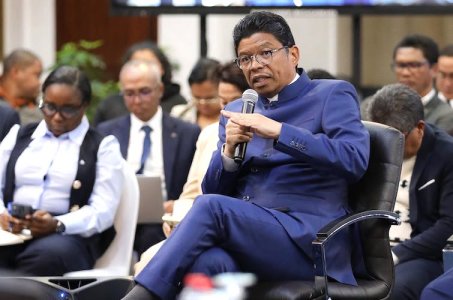
Discussions between the Malagasy government and the International Monetary Fund (IMF) remain open despite the postponement of the country's financing program review. Economy and Finance Minister Herinjatovo Aimé Ramiarison affirmed that exchanges with the Bretton Woods institution continue in a climate of dialogue, with only one major point of divergence: the temporary suspension of the automatic fuel price adjustment mechanism. Authorities insist they want to convince their financial partners that this decision responds to economic and social necessity, without compromising commitments made under structural reform frameworks. During the presentation of Banky Foiben'i Madagasikara's monetary policy report at Carlton in Anosy, the Finance Minister sought to reassure on IMF relations. According to him, this is not a breakdown in negotiations but a specific disagreement requiring further discussions. The government intends to provide detailed explanations for suspending the automatic fuel price adjustment mechanism. This decision had immediate consequences on the international financing schedule. The IMF Board was to examine on July 17 the third and fourth reviews of programs supported by the Extended Credit Facility (ECF) and the Resilience and Sustainability Facility (RSF). This item was ultimately removed from the agenda, resulting in postponement of the $183 million disbursement initially planned to support the state budget. For the government, this disagreement does not undermine overall IMF commitments. The minister emphasizes that Madagascar meets nearly all criteria and structural benchmarks required under both programs. The fuel question remains, according to him, the sole disagreement between the parties. The automatic price adjustment mechanism was among the conditions for implementing IMF agreements. Its objective is to gradually pass on international oil price variations to pump prices to limit state budget charges. But facing global oil price surges caused by Middle East geopolitical tensions, Malagasy authorities chose to temporarily suspend this mechanism under energy emergency status. The government believes an immediate fuel price increase would significantly impact the entire economy. Transport costs, essential goods, and production would rise rapidly, fueling already concerning inflation. Authorities also fear this could weaken household purchasing power and trigger social tensions compromising current economic recovery momentum. Madagascar plans to maintain fuel prices at current levels until end of 2026. This approach is presented as an exceptional measure to cushion external shocks. The government clarifies it does not abandon the automatic adjustment principle but wishes to defer its application. A gradual return to true pricing is envisaged from January 2027 to limit economic and social impacts. The IMF, meanwhile, primarily seeks guarantees on the financial sustainability of this strategy. The institution wants to know financing modalities for potential subsidies needed to compensate for the price freeze and measures to preserve budget balance. To address these concerns, the Economy and Finance Ministry highlights several levers. Authorities plan to strengthen tax revenues, intensify anti-fraud and tax evasion efforts, continue public spending control, and maintain prudent debt policy. These efforts should absorb the temporary cost of the measure without compromising public finance stability. Simultaneously, the government intends to accelerate several structural reforms, particularly in the energy sector. Jirama's recovery and renewable energy development rank among stated priorities to gradually reduce the country's dependence on imported fuel thermal plants. Authorities also recall that a delegation already visited Washington to present these arguments to IMF officials. While this initial effort did not secure immediate agreement, Madagascar remains committed to ongoing negotiations.
Source: Madagascar Tribune