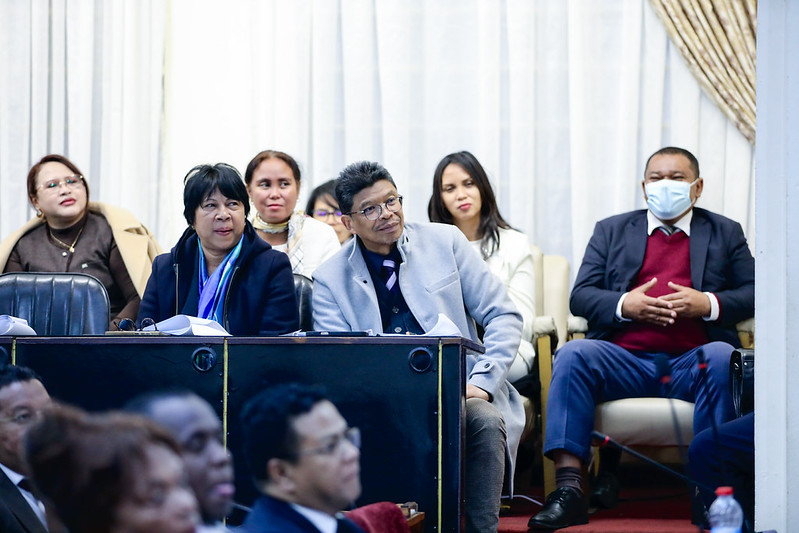
Debates on the 2026 Revised Budget Bill (PLFR) in plenary session, followed by unanimous vote at the Tsimbazaza National Assembly. The Revised Budget Bill (PLFR) 2026 continues its institutional journey. The text was voted on, with amendments, at the National Assembly on June 22, following lengthy plenary debates. For the Government, the exchanges were essential, with deputies called upon to voice the concerns and expectations of the population. According to the Minister of Economy and Finance, Dr Ramiarison Herinjatovo Aimé, the spirit of this PLFR rests on three pillars: equity, consideration of social aspirations, and economic revival. The text first aims to provide concrete social responses. The integration of a housing allowance of 200,000 ariary for civil servants follows this logic. In a context marked by pressure on purchasing power, this measure aims to support state employees and ease certain daily difficulties. The Government believes that unaddressed social inequalities can fuel frustration, weaken national cohesion, and become a factor of instability.
Equity. On the fiscal side, the 2026 PLFR emphasizes the principle of fairer contribution. Certain measures specifically target luxury goods, whose imports mainly benefit the wealthiest households while straining foreign exchange reserves. The stated objective is not to slow economic activity, but to better distribute the tax burden according to real contributive capacity and national priorities. Protection of local production is also a strong focus of the text. The taxation of secondhand clothing is presented as an economic and social measure intended to support national productive sectors. The massive influx of secondhand textiles has, over the years, weakened local industry, led to the closure of several production units, and fragmented the cotton sector. The PLFR thus aims to create a more favorable environment for SMEs, local production, and employment.
Outcome. The text also provides a more incentive-based approach in certain sectors. For local beer, the bill proposed a reduction in minimum taxation per liter, based on performance criteria. This should be accompanied by intensified activities, increased revenues, and a spillover effect on rural areas. However, this section was amended by deputies, who wish to maintain minimum taxation at 850 Ar per liter. In telecommunications, discussions focused on commitments regarding overall tax contribution and internet price reductions. But deputies also raised the issue of a tax rate that should be 8%, as in the case of pay television. However, the 2026 PLFR confirms the priority given to structural investments in water, electricity, roads, and social and economic infrastructure. Through this text, the Government defends a more responsible budgetary policy, where tax incentives must henceforth be justified by their real impact on the economy, employment, and the general interest. In short, after substantive exchanges and several reservations expressed at the start of the session, the minister's clarifications on the spirit and direction of the PLFR allowed positions to converge and led to the adoption of the text.