Madagascar has never lacked vision or builders — it has lacked a place where their work can endure beyond its creator. The Russian pivot of February 2026 is merely a recent case of an ancient reflex: preferring immediate action to deferred work, whenever an external shortcut — yesterday France, then multilateral lenders, today Moscow — allows it. This four-part series traces this thread, from diplomatic symptom to its institutional, fiscal, colonial and comparative roots.
I. The Survivor and the Builder
The Grand Theatre of the Kremlin
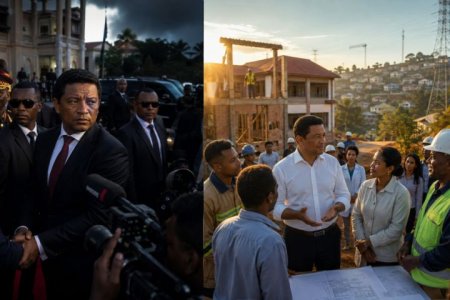
There is something profoundly absurd about the staging of February 18, 2026, at the Kremlin. Two men shake hands before the cameras and evoke, in the diplomatic language of circumstance, a "new era of cooperation"… The setting fills in over weeks: Russian armored vehicles, drones and assault rifles handed over with great ceremony to the presidential guard, Africa Corps trainers, a Russian-Malagasy chamber of commerce, co-produced broadcasts on Malagasy media with African Initiative — linked to Russian foreign services — singing the praises of the Putin-Madagascar idyll. The height of absurdity: the CENI draws closer to its Russian counterpart for upcoming elections… Putin's Russia, a shining model of electoral transparency… One could dwell on the calendar absurdity of this rapprochement. The Afrobarometer surveys of 2024-2025, covering thirty-eight African countries, establish it conclusively: Russia is, of all international actors tested, the least appreciated — thirty-six percent favorable opinions, far behind China, the African Union, the United States, and even the European Union, despite lobbyists, influencers and propaganda operations. Angola, a historical Moscow ally for half a century, has just expelled the diamond merchant Alrosa and VTB bank, and exposed a Russian influence operation disguised as a cultural center. In Mali, ostensibly the showcase most favorable to the winning hand the Malagasy junta claims to play, the Africa Corps shamefully had to flee Kidal. Everywhere it has deployed on the continent, the Russian gambit displays a widely documented record of failure. But we must not mistake the debate. The Russian rapprochement exposes a symptom of the syndrome I already characterized in January 2025 as "poor man's geopolitics" — that of structurally fragile nations which, lacking a clear development path, exhaust themselves chasing image rather than consolidating their foundations.
The Time of the Survivor
Russia invented nothing in this logic: it is simply the immediate partner of the moment. Tomorrow, another name will do — it matters little which. The problem is not Moscow. The problem is that Malagasy power, whatever form it takes, reasons structurally in the time of the survivor, not in the time of the builder. This is not a rhetorical convenience: a survivor and a builder do not have the same relationship to time — they simply do not have the same incentive to have one. Since 2002, no Malagasy government has come to power through pure administrative continuity: contested elections, power grabs, military transitions have succeeded one another without interruption. Each regime born of a rupture must first legitimize itself and buy the peace of its coalition — the army, the inner circle, a few lenders of last resort. This is exactly what selectorate theory describes: when a leader's survival depends on a minimal coalition rather than a broad contract with the population, the logic of power no longer consists of producing public goods whose effects are measured over decades — roads, schools, electrical networks, rule of law — but of distributing private, immediate and visible advantages to this coalition: salaries paid, equipment delivered, ceremonies organized jointly. The delivery of Russian armored vehicles to the presidential guard responds exactly to this logic: to reward immediately and spectacularly the forces whose loyalty can guarantee the regime's survival — support for resources, equipment, privileged recognition. A power plant, by contrast, provides no direct benefit to this coalition, and its effects are far too slow to enter into this calculation.
Taxation Without Contract
A second, deeper reason, drawn from the historical sociology of the state. The extreme weakness of state resources stems from the extreme weakness of its taxation — a problem no one really wants to tackle, for the same political reasons: its high social cost, and the inability to imagine over a longer timeframe the necessary compensations. These same contradictions — the cost of gasoline, the cost of energy kept artificially low through subsidies — express themselves here, even if it bleeds the economy and deprives the state of its main resources. A state co...