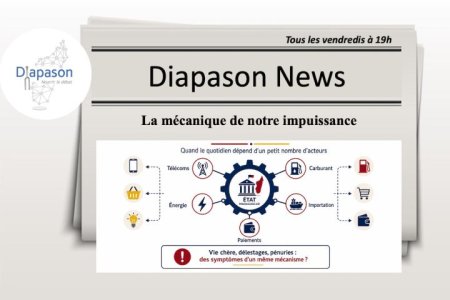
Introduction Every morning, millions of Malagasies check their phones, take a taxi-be, buy rice or hope the electricity lasts until evening. Yet these ordinary gestures depend on essential services: telecommunications, fuel, energy, imports, distribution and payment. When one of them breaks down, daily life falters. For decades, governments and promises have succeeded one another, but the same difficulties persist: high cost of living, power cuts, shortages, delayed investments and recurring crises. These problems are often treated separately. What if they were, in reality, symptoms of the same mechanism? This article proposes to start from the facts, measure their consequences, then trace back to the causes, without accusation or oversimplification.
1. Our daily life depends on a limited number of actors
Madagascar has more than 30 million inhabitants. Each day, everyone depends on essential services to communicate, move around, eat, access healthcare or energy. Yet several of these functions are concentrated among a few large groups present in telecommunications, imports, distribution, fuel, finance and real estate. Some come from the karana community, which represents less than 0.2% of the population, alongside other national and international actors. These companies have invested, created jobs and provided useful services. The problem is therefore not their existence, but the level of collective dependence on a restricted number of actors operating in essential sectors. The question is then simple: What happens when the daily life of more than 30 million people depends on such a small number of actors?
2. The consequences: when the same difficulties become our daily reality
Economic mechanisms are often invisible. Their effects are known to all: a salary that doesn't last until the end of the month, more expensive fuel, delayed deliveries, a student studying by candlelight, a shopping basket that keeps rising. Since 1971, GDP per capita has fallen from approximately 848 to 460 dollars, while the population has grown from about 7 to more than 30 million inhabitants. For many families, income covers fewer and fewer essential expenses. Food absorbs more than 60% of the budget of the poorest urban households. In Madagascar, a rise in fuel or imported products quickly spreads to transport, food, materials and services. The citizen doesn't follow economic indices: they notice that everything increases. Power cuts produce the same cascading effect. Businesses, shops, students and health centers must adapt to an uncertain service. Similarly, a fuel shortage or supply delay can, within days, disrupt part of the country. After seeing the same difficulties return repeatedly, many Malagasies develop a sense of resignation. According to Afrobarometer, a majority judge the economic situation as bad. Behind this observation, one impression dominates: "I work, but I'm not getting ahead." The question then becomes inevitable: Why do the same consequences return, regardless of which government is in power? To answer this, we must move beyond symptoms and look at the mechanism.
3. The mechanism: when certain actors become difficult to replace
Two realities converge: our daily life depends on a small number of actors, while the same difficulties return over the years. This link can be explained by capture through indispensability. An actor becomes indispensable when they control an essential function and no credible alternative can replace them quickly. This is not necessarily illegal. It is a relationship of dependence. The more difficult this actor becomes to replace, the higher the cost of challenging them. The State hesitates to change the rules, consumers have fewer choices and competitors struggle to enter the market. Power therefore does not come only from wealth. It comes from the absence of alternatives. An actor present in fuel, telecommunications, imports or infrastructure can thus acquire strong influence simply because any disruption would have immediate consequences for the population. This mechanism does not assume conspiracy or malicious intent. It often results from an accumulation of decisions, investments, competitive weaknesses and public choices. True power appears when an actor becomes so difficult to replace that society must adapt to them rather than the reverse. It remains to understand how Madagascar reached this point.
4. The root causes: a dependence built over time
This dependence formed gradually, at the intersection of political choices, economic constraints, historical circumstances and structural weaknesses. Understanding it requires examining not individual actors, but the system that made them indispensable.