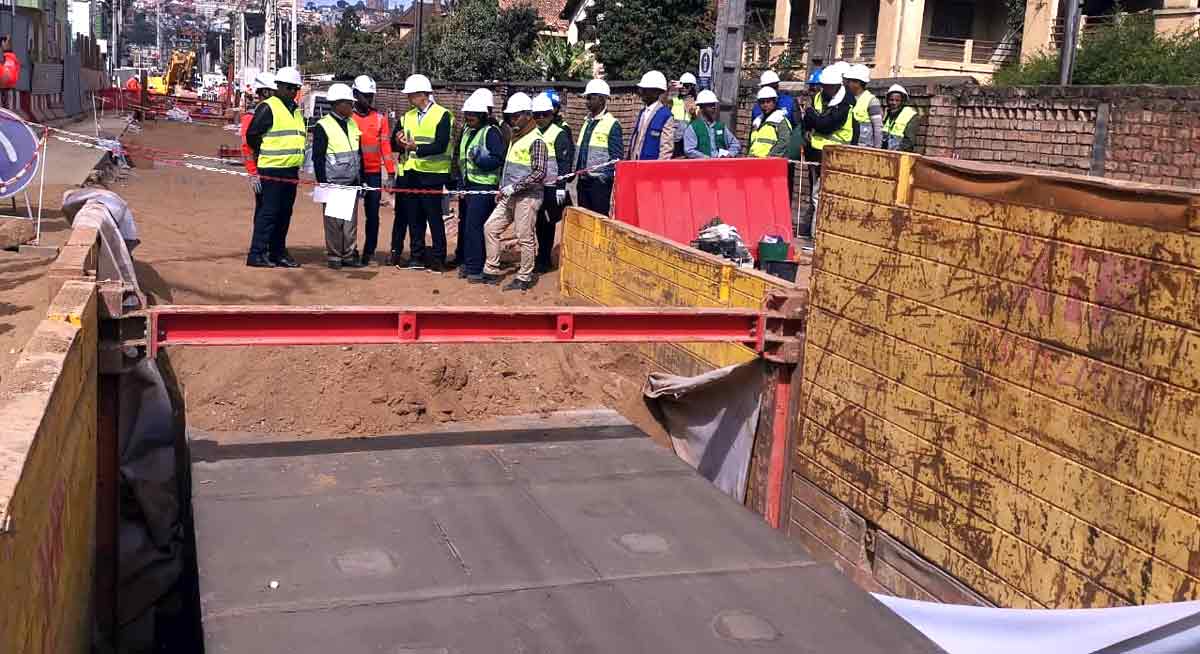
Three months after the official launch of the first phase of works, the Integrated Sanitation Program for Antananarivo – Phase II (PIAA2) is advancing on multiple fronts. A site visit was organized on Monday, June 22, 2026 by the Ministry of Water, Sanitation and Hygiene, through the Program Management Unit, to assess the progress of ongoing operations on the ground. The delegation, comprising representatives from the ministry, the French Development Agency, the Urban Municipality of Antananarivo and institutional stakeholders, visited two major sites: Antanimena-Analakely and Mahamasina-Stade Barea. The objective was to review achievements already undertaken, technical challenges encountered and the next steps of the program.
At Antanimena and Analakely, works focus on improving drainage systems. They aim to strengthen rainwater evacuation infrastructure, facilitate stormwater runoff flow and reduce flooding risks in this strategic area of the capital. This operation currently shows a physical progress rate of 20.48%. Diversion works continue, while the start of phase 1 at Analakely is planned soon. For phase 3, excavation material deposits are scheduled from June 27, preceded by an awareness campaign among residents and Fokontany concerned.
On schedule. At Mahamasina, interventions concern strengthening rainwater evacuation systems around Stade Barea. The site is also progressing according to the established schedule, with overall progress of 17.74%. Phase 1 is much more advanced, with a completion rate of 63.65%. Temporary arrangements and safety devices will be installed at the spillway structure to maintain pedestrian and motorcycle passage, particularly during national holiday periods. Traffic on Saint-Michel road towards Anosy will be partially open to light vehicles during Independence Day, before permanent opening planned for mid-July.
Beyond visible works, PIAA2 addresses a major challenge for Antananarivo: limiting the effects of recurring floods, which affect mobility, economic activities, public health and residents' living conditions. The program, co-financed by the AFD, the European Union and the Malagasy State, has total funding of 53 million euros. Ultimately, these investments should reduce the frequency and duration of floods, improve rainwater evacuation, limit health risks from stagnant water and protect urban infrastructure. They also help strengthen the capital's resilience to climate change. Through this visit, partners reaffirmed their shared commitment to a better-sanitized, safer city better prepared for urban challenges in the coming decades.
Economy
Urban Sanitation: Concrete Phase Underway on Capital Projects, Says PIAA2
Source: Midi Madagasikara